


Modern enterprises generate an overwhelming amount of unstructured data every day, including emails, reports, contracts, support tickets, meeting notes, product documentation, policies, and research papers. Without an organized system to classify this information, valuable knowledge often becomes difficult to locate, leading to reduced productivity and slower decision-making.
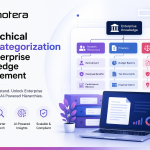
This is where hierarchical text categorization (HTC) plays a transformative role. Unlike traditional flat classification methods, hierarchical text categorization organizes documents into parent and child categories, creating a structured knowledge hierarchy that mirrors how businesses naturally organize information. Combined with high-quality training datasets from a trusted data annotation company, hierarchical classification significantly improves enterprise knowledge management systems and enhances AI-driven search, automation, and analytics.
In this blog, we'll explore hierarchical text categorization, its benefits, enterprise applications, implementation challenges, and why accurate annotation is the foundation of successful AI models.
What Is Hierarchical Text Categorization?
Hierarchical text categorization is a machine learning approach that classifies text into multiple levels of categories instead of assigning a single label.
For example:
Corporate Documents
- Human Resources
- Recruitment
- Employee Benefits
- Performance Reviews
- Finance
- Budget Reports
- Tax Documents
- Expense Claims
- Legal
- Contracts
- Compliance
- Intellectual Property
Instead of simply labeling a document as "Finance," HTC can classify it further as "Finance → Budget Reports," providing much greater context and improving information retrieval.
The hierarchical structure closely resembles how enterprise knowledge bases, document management systems, and digital repositories are organized.
Why Enterprise Knowledge Management Needs Hierarchical Categorization
Large organizations often manage millions of documents across multiple departments.
Without structured categorization, businesses face several challenges:
- Duplicate information
- Difficult document retrieval
- Inefficient knowledge sharing
- Compliance risks
- Poor employee productivity
- Limited AI search accuracy
Hierarchical categorization creates logical relationships between documents, making enterprise knowledge bases significantly easier to navigate.
Employees no longer need to search through thousands of files. AI systems understand both broad and specific contexts, delivering more relevant search results.
How Hierarchical Text Categorization Works
The workflow generally consists of several stages.
1. Data Collection
Organizations gather documents from various sources:
- Email archives
- CRM systems
- Internal wikis
- Knowledge bases
- Contracts
- Product documentation
- Customer support platforms
2. Text Annotation
Before AI models can learn hierarchical relationships, documents must be labeled correctly.
Professional annotation teams assign both primary and secondary categories according to predefined taxonomies.
For example:
Document:
"Quarterly Revenue Forecast"
Labels:
- Finance
- Financial Planning
- Revenue Forecasting
Working with an experienced text annotation company ensures consistent labeling standards across massive datasets.
3. Model Training
Machine learning algorithms analyze:
- Keywords
- Semantic meaning
- Context
- Document structure
- Metadata
- Relationships between categories
Transformer-based NLP models are particularly effective for hierarchical classification because they understand language context beyond individual words.
4. Continuous Learning
As organizations create new document types, annotation teams update taxonomies and training datasets, allowing models to evolve alongside business needs.
Many enterprises rely on text annotation outsourcing to continuously maintain and improve these large-scale datasets.
Benefits of Hierarchical Text Categorization
Improved Enterprise Search
Employees find information faster because AI understands category relationships instead of relying solely on keyword matching.
Searching for "employee insurance" automatically prioritizes HR benefits documents instead of unrelated insurance files.
Better Knowledge Discovery
Hierarchical organization reveals relationships between documents that traditional search engines often miss.
This enables teams to uncover relevant policies, reports, or historical decisions more efficiently.
Enhanced AI Assistants
Enterprise chatbots and virtual assistants perform significantly better when documents are organized into hierarchical categories.
Instead of retrieving generic information, AI delivers department-specific, topic-specific answers.
Increased Productivity
Employees spend less time searching for documents and more time completing high-value work.
Well-organized knowledge repositories reduce repetitive questions and improve cross-functional collaboration.
Improved Compliance
Regulated industries must store and retrieve documents according to strict governance policies.
Hierarchical categorization makes compliance audits much faster by organizing documents into legally required structures.
Scalable Knowledge Management
As enterprises grow, document volumes increase exponentially.
Hierarchical categorization scales far better than manually organizing folders or relying on simple tagging systems.
Industry Applications
Banking and Financial Services
Banks classify documents across multiple levels:
- Loans
- Mortgage Applications
- Credit Risk
- Regulatory Compliance
- Investment Products
This improves operational efficiency while supporting regulatory requirements.
Healthcare
Hospitals organize:
- Patient Records
- Medical Imaging Reports
- Clinical Guidelines
- Insurance Documentation
- Research Publications
Hierarchical categorization accelerates information access for healthcare professionals.
Legal Services
Law firms manage:
- Client Contracts
- Litigation Documents
- Intellectual Property
- Employment Law
- Corporate Governance
Structured document classification minimizes retrieval time and improves legal research.
Manufacturing
Manufacturers categorize:
- Product Manuals
- Quality Assurance Reports
- Maintenance Logs
- Supplier Documentation
- Safety Procedures
This creates a centralized knowledge ecosystem across production teams.
Customer Support
Support organizations classify tickets based on:
- Product
- Issue Type
- Severity
- Customer Segment
- Resolution Status
AI-powered ticket routing becomes more accurate with hierarchical categorization.
Why Data Annotation Matters
Even the most advanced NLP models cannot learn organizational hierarchies without accurately labeled training data.
Annotation teams define:
- Parent-child relationships
- Category definitions
- Multi-label classifications
- Edge cases
- Ambiguous documents
- Taxonomy updates
A reliable data annotation company ensures that annotations remain consistent across thousands—or even millions—of enterprise documents.
Poor-quality annotations often result in inaccurate predictions, inconsistent document retrieval, and ineffective AI systems.
Best Practices for Successful Hierarchical Text Categorization
Develop a Clear Taxonomy
Create logical parent and child categories that accurately reflect business processes.
Maintain Annotation Guidelines
Detailed documentation ensures every annotator follows identical labeling rules.
Use Domain Experts
Subject matter experts help resolve ambiguous classifications in industries such as healthcare, finance, and legal services.
Regularly Update Categories
Business operations evolve, and enterprise taxonomies should evolve accordingly.
Perform Continuous Quality Assurance
Routine audits help maintain annotation accuracy and model performance over time.
Many enterprises choose data annotation outsourcing to access experienced annotation teams, scalable workflows, and rigorous quality control while reducing operational costs.
Why Choose Annotera?
Building an effective enterprise knowledge management system requires more than advanced AI algorithms—it requires high-quality annotated data.
At Annotera, we help organizations develop structured datasets that power intelligent document classification and enterprise search. As a trusted data annotation company, we provide scalable annotation solutions tailored to complex NLP and knowledge management projects.
Our experienced specialists create hierarchical taxonomies, multi-level document labels, and high-quality datasets that improve AI accuracy while supporting enterprise-scale deployments. Whether you need comprehensive text annotation outsourcing or end-to-end data preparation services, our team delivers consistent quality, secure workflows, and rapid turnaround times to accelerate your AI initiatives.
Conclusion
Hierarchical text categorization is becoming an essential capability for modern enterprise knowledge management. By organizing documents into structured, multi-level taxonomies, businesses can dramatically improve search accuracy, automate document organization, strengthen compliance, and unlock valuable organizational knowledge.
However, the success of hierarchical classification depends on the quality of the underlying training data. Partnering with an experienced text annotation company ensures AI models learn meaningful category relationships that deliver reliable, scalable results. As enterprise data continues to grow, organizations that invest in high-quality annotation and intelligent categorization will be better positioned to drive operational efficiency, informed decision-making, and long-term competitive advantage.