


As robots move beyond controlled industrial environments and into warehouses, healthcare facilities, homes, and public spaces, their ability to make intelligent decisions in unpredictable situations becomes increasingly important. Traditional robotics datasets can teach machines to recognize objects, estimate positions, or execute predefined movements. However, they often struggle to capture the reasoning and adaptability humans apply when interacting with complex physical environments.
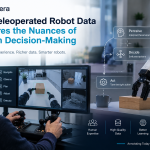
This is where teleoperation becomes valuable. Teleoperated robots allow humans to control robotic systems remotely while recording their actions, observations, and responses. These interactions generate rich datasets that contain more than simple movement trajectories. They capture how people interpret visual information, prioritize objectives, respond to uncertainty, and adjust their actions as circumstances change.
For developers building Physical AI systems, teleoperated interactions can therefore provide an important source of training information.
What Is Teleoperated Robot Data?
Teleoperation involves a human operator controlling a robot from a remote interface. Depending on the application, the operator may use joysticks, motion-capture equipment, haptic devices, VR controllers, or other interfaces to guide the robot.
During these sessions, robotic systems can collect multiple synchronized data streams, including camera feeds, depth information, joint positions, force measurements, velocity, control commands, and task outcomes. The result is a multimodal record of how a human interacts with the physical world through a robotic embodiment.
Importantly, the dataset can reveal not only what action was performed but also how the action evolved.
For example, consider a robot tasked with picking up an unfamiliar object. A human operator may initially approach the object, slow the robot near its surface, adjust the gripper angle after evaluating its shape, and modify the grasp when the object begins to slip. Each adjustment represents a response to environmental information.
These small decisions are precisely the kinds of behaviors that can help Physical AI systems become more adaptable.
Human Decisions Are Embedded in Robot Trajectories
A robot trajectory may appear to be a sequence of coordinates and control signals, but behind those signals are decisions Blockedword/sentencee by the operator.
Suppose a teleoperator sees two possible paths around an obstacle. Instead of choosing the shortest route, they may select the wider path because it provides greater clearance. Similarly, when reaching for an object, they may approach from a particular direction because it offers a more stable grasp.
These choices encode implicit knowledge.
Teleoperated data can expose patterns such as:
-
How humans prioritize safety versus speed
-
How operators respond to unexpected movement
-
How visual cues influence motor adjustments
-
How humans recover from unsuccessful actions
-
How operators choose between alternative strategies
-
How uncertainty affects movement speed and precision
When captured at scale, these patterns become valuable learning signals for robotic models.
The Importance of Contextual Information
One of the major advantages of teleoperated datasets is their contextual richness. A demonstration is not simply an isolated action. It can include the environment, task objective, object properties, operator actions, and outcome.
Consider a robot learning to place objects into containers. A simple trajectory dataset may show the robot moving an object from point A to point B. Teleoperation data can reveal considerably more. The operator may reposition the object after noticing that it is unstable, change the approach angle because the container is partially obstructed, or slow down when placing a fragile item.
This context helps models associate actions with environmental conditions.
For training systems intended to operate autonomously, such relationships are critical. Robots need to learn not merely how to move but when and why a particular movement is appropriate.
Capturing Corrections and Recovery Behaviors
Human decision-making becomes particularly visible when something goes wrong.
Perfect demonstrations can show a robot how to complete a task under favorable conditions. However, real-world environments rarely behave perfectly. Objects move, surfaces vary, sensors become noisy, and initial actions sometimes fail.
Teleoperation naturally produces recovery data because human operators can intervene when a robot encounters difficulty.
An operator might:
-
Detect that a grasp is unstable.
-
Pause or reduce movement speed.
-
Reposition the gripper.
-
Attempt a different grasp.
-
Confirm that the object is secure.
-
Continue the task.
This sequence contains valuable information about failure detection and corrective behavior.
Such examples can help models learn that successful robotics is not simply about executing a fixed sequence. It also involves recognizing deviations and selecting appropriate responses.
Turning Teleoperation Into High-Quality Training Data
Raw teleoperation recordings are not automatically ready for machine learning. They may contain redundant movements, sensor noise, inconsistent demonstrations, missing metadata, or ambiguous task boundaries.
Data processing and annotation are therefore essential.
Annotation teams can identify task phases, object interactions, action segments, environmental conditions, operator interventions, successful and unsuccessful attempts, and other relevant events. Temporal labeling can connect specific robot actions with changes in the surrounding environment.
This is where specialized robotics data annotation services can add significant value. Rather than treating each sensor stream independently, annotation workflows can preserve relationships between vision, motion, language, and control signals.
For example, an annotated demonstration could associate a visual observation with the operator's decision to slow down, followed by a successful grasp. Such structured relationships make the resulting dataset more useful for behavior learning and model evaluation.
From Demonstrations to Physical AI Training Data
The broader goal is to transform human demonstrations into reusable Physical AI training data.
Physical AI systems must connect perception with action. They need to interpret the environment, understand task objectives, predict consequences, and execute physical behaviors. Teleoperation provides a practical mechanism for collecting examples across these stages.
When datasets include diverse operators, environments, objects, task variations, and recovery strategies, they can provide models with a broader behavioral foundation.
For instance, multiple operators may solve the same manipulation task differently. One might prioritize speed, another precision, and another collision avoidance. Rather than treating this variation as unwanted noise, dataset designers can use it to expose models to multiple valid strategies.
This diversity can support more robust learning and reduce dependence on a single operator's behavior.
Human Expertise as a Data Source
A key insight from teleoperated robotics is that human expertise can be converted into machine-readable experience.
People continuously make judgments that are difficult to express through explicit programming. They estimate whether an object is stable, recognize when a surface appears slippery, decide when to slow down, and alter strategies when conditions change.
Teleoperation captures these judgments indirectly through action.
With appropriate annotation and processing, those actions become structured examples of perception-to-decision-to-action relationships. This makes teleoperation especially relevant to emerging robot learning approaches that seek to combine visual understanding, language instructions, and physical control.
Building Better Datasets for Generalization
The usefulness of teleoperated data ultimately depends on its diversity and quality. A dataset collected from one operator performing one task in one environment may have limited generalization.
More effective datasets deliberately incorporate variation.
Collection programs can vary lighting, object appearance, workspace layouts, task conditions, operator behavior, and degrees of difficulty. Edge cases and unsuccessful attempts should also be represented where appropriate.
Annotation should preserve meaningful context rather than reducing demonstrations to generic movement labels.
The objective is to create datasets that reflect the complexity robots will encounter after deployment.
Conclusion
Teleoperated robot data offers a powerful window into human decision-making in physical environments. By recording how operators perceive situations, adjust movements, respond to failures, and select between alternative actions, teleoperation captures behavioral information that conventional scripted datasets often miss.
For organizations developing intelligent robotic systems, the challenge is to convert these rich demonstrations into consistent, scalable, and machine-learning-ready datasets. High-quality annotation plays an important role in that process by connecting observations, actions, decisions, and outcomes.
As Physical AI continues to develop, teleoperation will remain an important bridge between human expertise and autonomous robotic behavior. The better these human demonstrations are captured, contextualized, and annotated, the greater their potential to help robots operate safely and intelligently in the unpredictable physical world.