




Search technology has evolved significantly beyond matching keywords and displaying pages containing identical phrases. Modern users expect search engines, enterprise knowledge platforms, and AI-powered applications to understand the meaning behind their queries and retrieve information that closely matches their actual requirements. This capability is known as semantic search.
Unlike traditional keyword-based search, semantic search focuses on understanding context, relationships, user intent, and the meaning of natural language. However, building systems that accurately interpret these elements requires more than advanced algorithms. They also need high-quality, structured training data.
This is where text annotation becomes essential. By assigning meaningful labels to textual information, identifying entities, categorizing user queries, and capturing contextual relationships, annotation helps machine learning models understand language more effectively. Businesses increasingly rely on professional text annotation outsourcing services to develop reliable datasets that improve semantic search and information retrieval performance.
1. Understanding Semantic Search and Information Retrieval
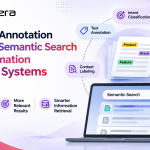
Semantic search is an AI-driven approach that interprets the meaning and context of a search query rather than relying exclusively on exact keyword matches.
For example, when someone searches for "affordable smartphones with excellent cameras," a traditional search engine may prioritize pages containing those exact words. A semantic search system can understand that the user is looking for budget-friendly smartphones with strong pBlockedword/sentenceography capabilities, even when product descriptions use different terminology.
Information retrieval systems complement semantic search by identifying, organizing, and delivering relevant information from large collections of documents, databases, websites, and knowledge repositories.
These systems commonly use technologies such as:
-
Natural Language Processing (NLP)
-
Machine Learning and Deep Learning
-
Vector embeddings and similarity search
-
Named Entity Recognition (NER)
-
Large Language Models (LLMs)
-
Knowledge graphs and semantic indexing
For these technologies to perform effectively, their underlying models require accurately annotated text datasets.
2. How Text Annotation Helps Models Understand Context
Human language contains ambiguity, synonyms, industry-specific terminology, and expressions that can have different meanings depending on context.
Text annotation helps address these challenges by converting unstructured language into structured, machine-readable information.
Annotators assign labels to words, phrases, sentences, and complete documents according to predefined guidelines. These labels help machine learning models recognize linguistic patterns and understand relationships between different textual elements.
For example, consider the search query:
"Find affordable cloud storage solutions for small businesses."
An annotated dataset may identify:
-
Intent: Product discovery
-
Entity: Cloud storage solutions
-
Price attribute: Affordable
-
Target auBlockedword/sentencence: Small businesses
-
Context: Business technology requirements
Such structured information helps semantic search systems interpret user requirements and retrieve more relevant results.
3. Key Text Annotation Techniques Used in Semantic Search
Different annotation techniques contribute to different aspects of semantic understanding and information retrieval.
A. Intent Classification
Intent classification identifies the purpose behind a user's search query. It helps systems distinguish between informational, navigational, transactional, and commercial investigation queries.
For example:
-
"What is cloud computing?" – Informational intent
-
"Visit the Microsoft website" – Navigational intent
-
"Buy enterprise cloud storage" – Transactional intent
-
"Best cloud storage providers for businesses" – Commercial investigation
Accurate intent classification enables search engines and AI-powered applications to prioritize results according to user expectations.
It is particularly valuable for conversational search platforms, virtual assistants, recommendation engines, and customer support applications.
B. Named Entity Recognition (NER)
Named Entity Recognition involves identifying and categorizing important entities within text, including people, organizations, locations, products, dates, and technical terms.
For example, in the sentence "Annotera provides data annotation services for AI companies," an annotation dataset can identify:
-
Organization: Annotera
-
Service: Data annotation services
-
Industry: Artificial Intelligence
NER improves entity-based search, allowing information retrieval systems to connect relevant documents even when users search using different variations of an entity's name.
C. Semantic Relationship Annotation
Understanding individual words is not always sufficient to determine the meaning of a sentence. Models must also recognize relationships between entities and concepts.
Semantic relationship annotation identifies connections such as:
-
Product–Manufacturer
-
Employee–Organization
-
Service–Industry
-
Technology–Application
-
Location–Business
These relationships help build knowledge graphs and improve contextual search capabilities.
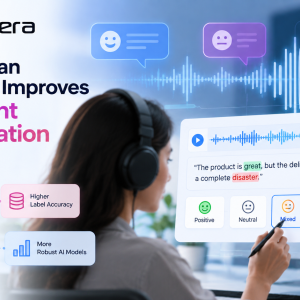
D. Sentiment and Context Annotation
Sentiment annotation identifies opinions, emotions, and subjective expressions within textual content.
For example, an enterprise search platform analyzing customer feedback may distinguish between positive product reviews, negative experiences, and neutral observations.
Context annotation further helps models interpret ambiguous expressions, domain-specific language, and phrases whose meanings change depending on surrounding text.
4. Improving Search Relevance Through High-Quality Training Data
Search relevance depends heavily on how accurately a system understands the relationship between a query and available content.
Text annotation supports this process by creating labeled datasets that help machine learning models learn what constitutes a relevant result.
For example, an e-commerce search system may receive the query "waterproof running shoes for women."
An annotated dataset can help the model recognize:
-
Product category: Running shoes
-
Feature: Waterproof
-
Target auBlockedword/sentencence: Women
-
Search intent: Product discovery
When these attributes are properly labeled, the search system can retrieve relevant products even when their descriptions use alternative expressions such as "water-resistant women's athletic footwear."
This improves query understanding, reduces irrelevant search results, and creates a more consistent user experience.
5. The Role of Text Annotation in Vector Search and LLM-Based Retrieval
Modern information retrieval systems increasingly use vector databases and embedding models to identify semantically similar content.
Vector embeddings represent words, sentences, or documents as numerical vectors. These representations allow systems to identify similarities based on meaning rather than exact keyword matches.
However, embedding models need representative and high-quality training datasets to develop reliable semantic understanding.
Annotated datasets support this process by providing:
-
Query-document relevance labels.
-
Positive and negative training examples.
-
Contextual sentence classifications.
-
Entity and relationship labels.
-
Domain-specific terminology.
Text annotation also plays an important role in Retrieval-Augmented Generation (RAG) systems. RAG applications retrieve relevant information from external knowledge sources before generating responses through LLMs.
Accurate annotation helps improve document categorization, metadata extraction, query understanding, and relevance evaluation. Consequently, better-structured retrieval datasets can contribute to more grounded and contextually relevant AI-generated responses.
6. Why Businesses Need Professional Text Annotation Services
Developing high-quality annotated datasets requires linguistic expertise, domain knowledge, consistent labeling guidelines, and systematic quality assurance.
For businesses managing millions of documents or processing large volumes of search queries, in-house annotation can become expensive and difficult to scale.
Partnering with an experienced text annotation company offers several advantages:
Scalability: Professional annotation teams can manage growing datasets and changing project requirements without requiring businesses to continuously expand internal teams.
Domain Expertise: Specialized annotators can work with industry-specific terminology across healthcare, finance, retail, technology, and other sectors.
Quality Assurance: Multi-level review processes, annotation guidelines, and inter-annotator agreement checks help maintain labeling consistency.
Faster Data Preparation: Structured workflows help accelerate dataset development for NLP models, semantic search engines, and AI-powered information retrieval applications.
Cost Efficiency: Outsourcing reduces the operational burden associated with recruiting, training, and managing large annotation teams.
At Annotera, we support AI development initiatives with structured text annotation workflows designed to prepare high-quality training datasets for NLP, conversational AI, and other language-driven applications.
7. Best Practices for Preparing Text Annotation Datasets
To maximize the effectiveness of annotated datasets, businesses should follow a consistent data preparation strategy.
-
Define clear annotation guidelines: Establish standardized labeling instructions to minimize ambiguity and inconsistencies.
-
Include diverse search queries: Use different sentence structures, synonyms, Blockedword/sentenceing variations, and conversational expressions.
-
Prioritize contextual accuracy: Evaluate words and phrases within their surrounding sentences rather than labeling them in isolation.
-
Implement quality checks: Use expert reviews, sample audits, and inter-annotator agreement measurements.
-
Address edge cases: Include ambiguous queries, overlapping intents, incomplete sentences, and domain-specific expressions.
-
Continuously update datasets: Incorporate new terminology, changing user behavior, and model performance feedback.
These practices help create reliable datasets that support continuous improvements in semantic search and information retrieval.
Conclusion
Semantic search and intelligent information retrieval are transforming how businesses organize, discover, and access information. However, the effectiveness of these technologies depends significantly on the quality and structure of their underlying training data.
Text annotation provides the foundation for teaching AI models to recognize user intent, identify entities, understand contextual relationships, and distinguish relevant information from unrelated content.
As organizations increasingly adopt NLP, vector search, and LLM-powered retrieval systems, investing in high-quality annotation becomes a strategic requirement rather than an optional step.
Annotera helps businesses build structured, reliable training datasets through professional text annotation capabilities. Whether developing semantic search engines, conversational AI applications, or enterprise information retrieval platforms, the right annotation strategy can help improve model understanding, search relevance, and overall AI performance.