

Outdoor adventures often take you far beyond smooth pavement. Whether you are heading into the woods for hunting, carrying fishing equipment to a remote lake, or setting up camp miles from the nearest road, an all-terrain e-bike can make the journey faster and less physically demanding.
The best all-terrain e-bikes combine wide tires, capable motors, dependable batteries, strong brakes, and enough cargo capacity for outdoor gear. Here is what to look for and which types of e-bikes work best for hunting, fishing, and camping.
What Makes a Good All-Terrain E-Bike?
An all-terrain electric bike needs to handle much more than ordinary city streets. Dirt roads, gravel, sand, mud, roots, and uneven trails can quickly expose the limitations of a commuter-oriented bike.
Important features include:
-
Fat tires: Tires around 4 inches wide can provide additional traction and stability on loose surfaces.
-
Strong motor: Extra torque helps when climbing hills or carrying heavy equipment.
-
Long range: Remote trips may involve many miles without access to a charger.
-
Suspension: Front or full suspension can improve control and comfort on rough terrain.
-
High payload capacity: Hunters and campers often carry substantial equipment.
-
Hydraulic disc brakes: Reliable braking is particularly important on steep or unpredictable terrain.
-
Accessory compatibility: Racks, baskets, trailers, bags, and other accessories can make an e-bike considerably more useful outdoors.
1. Himiway D5 2.0 20" – Best Compact All-Terrain Choice
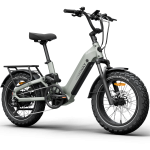
For riders looking for a combination of rugged capability and a relatively compact design, the Himiway D5 2.0 20" is an interesting option for hunting, fishing, camping, and recreational trail riding.
The bike uses a 750W motor producing up to 90 Nm of torque, giving it useful climbing ability when riding on hills or carrying outdoor equipment. Its 20 × 4-inch fat tires provide a large contact patch for traction on gravel, dirt, grass, and other loose surfaces.
Another advantage is its full-suspension design. With approximately 90 mm of front suspension and 100 mm at the rear, the bike can absorb bumps and uneven terrain better than a rigid-frame e-bike.
The D5 2.0 20" also has a 48V 15Ah (720Wh) battery, with a claimed pedal-assist range of up to 70 miles under favorable conditions. Actual range will vary substantially with terrain, rider weight, temperature, assistance level, tire pressure, and cargo.
Its 440-pound maximum payload capacity is especially useful for outdoor applications. That extra capacity provides flexibility when carrying fishing tackle, camping equipment, food, or other supplies.
The relatively low 19.3-inch standover height and recommended rider range of approximately 4'11" to 6'3" can also make the bike easier to handle for riders who find large 26-inch fat-tire bikes cumbersome.
For someone who wants a compact fat tire ebike that can transition between everyday riding and outdoor adventures, the Himiway D5 2.0 20" offers a practical balance.
2. Long-Range Fat-Tire E-Bikes – Best for Remote Camping
Range becomes especially important when camping because charging opportunities may disappear once you leave developed areas.
For these trips, prioritize battery capacity and efficiency rather than simply choosing the bike with the biggest advertised range number. Manufacturer range figures are normally achieved under specific test conditions.
Real-world range can drop when you encounter:
-
Steep climbs
-
Soft sand or mud
-
Low temperatures
-
Heavy cargo
-
Strong headwinds
-
Low tire pressure
-
Frequent throttle use
-
High pedal-assist settings
If you plan to ride deep into the backcountry, calculate your route conservatively and maintain a substantial battery reserve for the return trip.
3. High-Payload E-Bikes – Best for Hunting
Hunting places different demands on an e-bike. A rider may need to carry a backpack, equipment, water, tools, and potentially tow additional cargo.
For this reason, maximum payload capacity deserves as much attention as motor wattage.
A hunting e-bike should ideally support a sturdy rear rack or compatible trailer. Fat tires are also useful when traveling over dirt roads, fields, forest trails, and other surfaces where narrow tires can lose traction.
Noise is another reason hunters consider electric bikes. Electric motors can provide transportation without the engine noise associated with many gas-powered off-road vehicles. However, riders should always check land-management regulations before taking an e-bike onto hunting land.
4. Cargo-Friendly E-Bikes – Best for Fishing
Fishing often involves bulky rather than extremely heavy equipment. Rods, tackle boxes, coolers, folding chairs, and other gear can be awkward to transport on a conventional bicycle.
Look for an e-bike with mounting points or compatibility with:
-
Front or rear racks
-
Panniers
-
Cargo baskets
-
Fishing rod holders
-
Trailers
Fat tires can be particularly useful when the route to a fishing location includes gravel, grass, dirt, or sandy surfaces.
Water resistance also matters, but remember that an e-bike being described as water-resistant does not make it waterproof. Avoid submerging the motor, battery, controller, or electrical connectors.
5. Full-Suspension E-Bikes – Best for Rough Trails
Full suspension is not essential for every outdoor rider, but it can make a noticeable difference on rocky and uneven trails.
A rear suspension system helps keep the rear wheel controlled while reducing impacts transferred to the rider. Combined with a suspension fork and high-volume fat tires, it can make long off-road rides more comfortable.
This is another area where the Himiway D5 2.0 20" fits naturally into the all-terrain category. Its combination of fat tires and front-and-rear suspension is designed to provide more cushioning than a typical rigid commuter e-bike.
How Much Motor Power Do You Need?
A powerful motor is useful, but wattage alone does not determine off-road performance.
Torque, gearing, wheel size, total weight, motor tuning, and traction all affect how an e-bike performs on a hill. For outdoor riding, paying attention to torque is particularly useful.
A 750W motor paired with strong torque output can be suitable for many recreational all-terrain situations. Riders carrying substantial loads or tackling extremely steep terrain should also consider gearing, brake performance, thermal management, and overall bike design rather than focusing solely on the motor's headline wattage.
Fat Tires vs. Regular Tires for Outdoor Riding
Fat tires are popular on hunting and camping e-bikes for a reason.
Their greater volume allows riders to use lower tire pressures where appropriate, improving comfort and traction on loose surfaces. They can be particularly useful on sand, gravel, snow, and rough dirt roads.
The trade-off is additional weight and rolling resistance. If most of your riding happens on pavement with only occasional gravel sections, a narrower tire may be more efficient.
For riders who regularly leave paved roads, however, a fat-tire setup generally offers greater versatility.
Don't Forget Local Trail Rules
Owning an all-terrain e-bike does not automatically mean you can ride it everywhere a traditional bicycle can go.
Rules vary between federal, state, local, and privately managed lands. Some trails permit only Class 1 e-bikes, while others prohibit motorized or electric bicycles entirely. Hunting areas may have additional seasonal or access restrictions.
Before traveling, check the rules published by the agency or organization responsible for the specific trail or property.