








The bond market is flashing red. The yield on the 30-year Treasury note reached 5.44% on Wednesday, its highest level since 2004, before slipping slightly on Thursday morning. The 10-year Treasury, which influences mortgage rates, briefly neared 5.15% on Thursday morning, a level it last reached in 2001.
Yields had already risen amid concerns about inflation and growing U.S. debt. They jumped further on Wednesday after stronger-than-expected economic data led investors to price in additional interest-rate hikes as the Federal Reserve battles inflation. Several members of the central bank's Federal Open Market Committee (FOMC), which sets rates, also signaled this week that they favor further increases.
"Four burners, all on high"Wall Street analysts said investors are increasingly concerned about a protracted conflict in the Middle East, with the U.S. and Iran exchanging fresh threats at this week's United Nations General Assembly in New York. Prolonged tensions could keep oil prices elevated, stoking inflation and increasing pressure on the Fed to raise its benchmark interest rate, economists said. l
On top of that, weak demand for a 5-year Treasury note auction on Wednesday forced the U.S. government to dangle higher yields to attract buyers. Bond yields and prices move in opposite directions, with rising yields signaling that investors are seeking higher returns as investments grow increasingly risky.
"When the world's largest borrower has to raise its price to find buyers, you MUST pay attention," said Mark Malek, the chief investment officer at Siebert Financial, in an email. "Yields don't only rise because the Fed says so. They rise when lenders demand more to lend — and every mortgage, corporate bond and small-business loan in America is ultimately priced off that same benchmark."
He added, "Growth, oil, a hawkish Fed and reluctant buyers. Four burners, all on high, all at once."
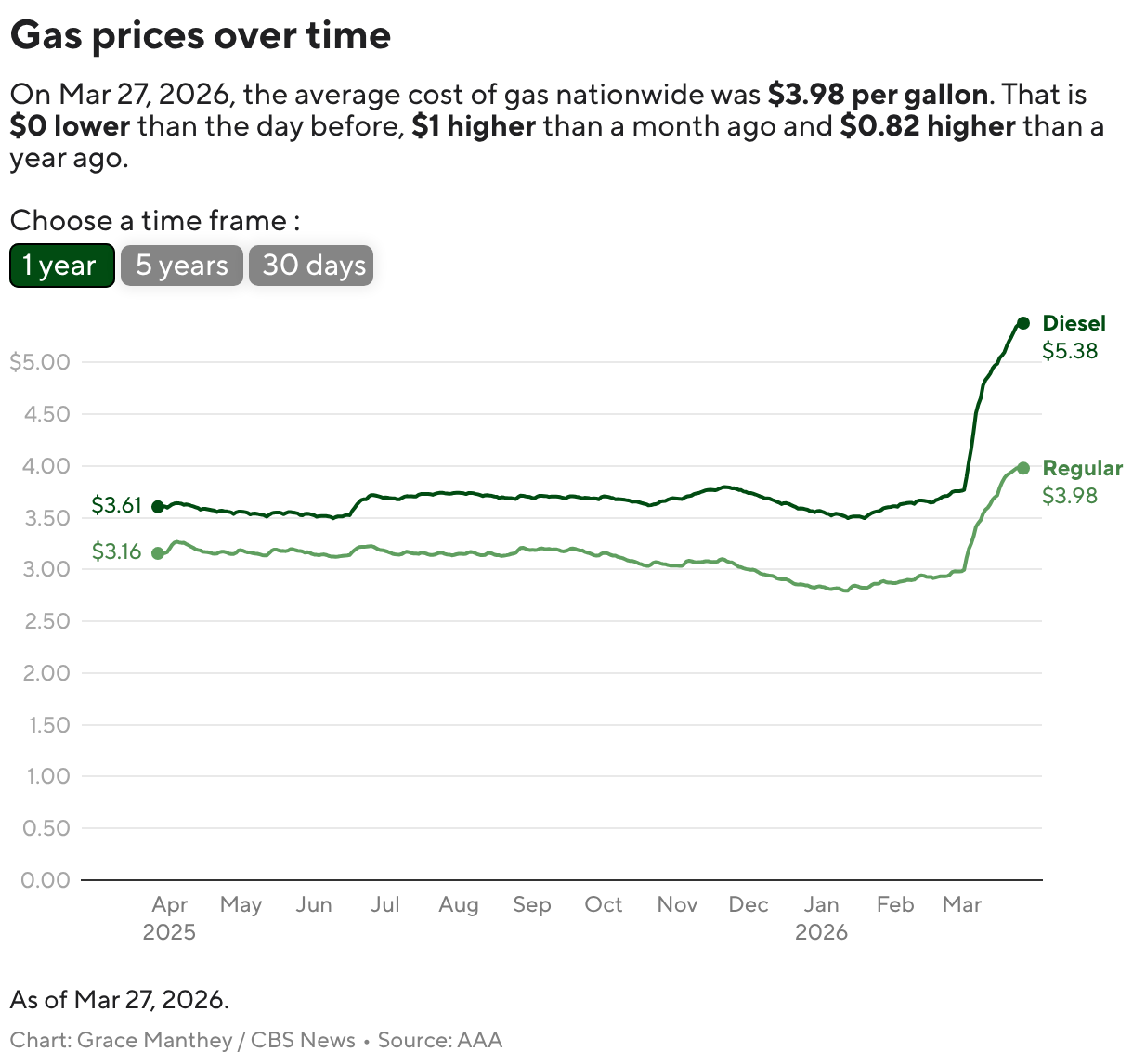
Investors are bracing for higher inflation after diesel prices in the U.S. hit a record high of $6.53 a gallon on Tuesday. Diesel is widely used in agriculture, trucking and construction, and economists warn that surging prices could seep into other parts of the economy, such as food and retail goods that must be shipped to stores across the country.
The Federal Reserve earlier this month raised interest rates for the first time since 2023, as Chairman Kevin Warsh underlined the central bank's goal of nudging inflation closer to its 2% annual target. Inflation, which had been approaching 2% at the start of the year, reignited after the Iran war drove up global oil prices. The Consumer Price Index stood at 3.4% on an annual basis in August.
Returning consumer prices to the Fed's preferred 2% pace could take years, with FOMC members earlier this month predicting that inflation may not dip to that level until 2029. Inflation could also continue to rise by year-end, reaching 3.7% in the fourth quarter, according to their median projections.
The jump in bond yields this week "is driven by inflation and the belief that it's going to take a lot more Fed rate hikes to curb it," Heather Long, chief economist at Navy Federal Credit Union, said in an email.
Traders of interest rate futures see a 70% chance of a quarter-point rate hike at the Fed's October meeting, followed by a 56% likelihood of another increase at its December meeting, according to CME FedWatch. (The FOMC doesn't have a rate-setting meeting in November.)
Those two additional hikes would bring the Fed's benchmark to between 4.25% and 4.5%, or about 0.75 percentage points higher than where it stood at the start of September. Some analysts also expect the Fed to further lift rates in 2027.
Economy heating upThe bond market got a major jolt on Wednesday after purchasing managers' data showed that U.S. business activity is growing at its fastest pace in years, while costs for corporate America are also rising quickly.
On Thursday, a government report showed that fewer U.S. workers applied for unemployment benefits last week, further strengthening expectations for the economy. A hotter economy could add to inflationary pressures, while a solid job market gives the Fed more leeway to raise borrowing costs.
Typically, the Fed turns to interest rate hikes to temper inflation and cool the economy. That's because higher borrowing costs tend to reduce consumer spending and business investment, slowing economic growth.
When unemployment is high, however, the Fed may cut interest rates to drive spending and make it cheaper for businesses to borrow and hire workers. The recent data showing a strengthening economy, combined with steady job growth, could open the door to more rate hikes, experts said.
"The biggest market risk right now may not be weak growth but excessive heat," Malek noted. "Strong economic activity is welcome, but it makes the Fed's inflation problem considerably harder."
What does it mean for your money?Higher borrowing costs make it more expensive to buy a home or car, use credit cards or tap other forms of debt. This week, the average rate for the 30-year mortgage surpassed 7%, its highest level in almost two years.
"On Main Street, this is yet another part of the affordability crunch," Long said.
Savers may modestly benefit if the Fed further boosts rates. Banks typically increase rates on savings accounts and CDs when the Fed raises its benchmark rate, though the increases vary by bank. Some savings accounts now offer annual percentage yields above 4%.
Higher yields also make newly issued bonds and short-term Treasuries more attractive to investors, while putting pressure on stocks, experts noted. But that can put pressure on the equity market if investors shift money away from stocks.
"Cash and short-term Treasuries have become legitimate portfolio competitors again," Malek said. "When investors can earn close to 5% without taking equity risk, every risky asset must clear a much higher hurdle."