



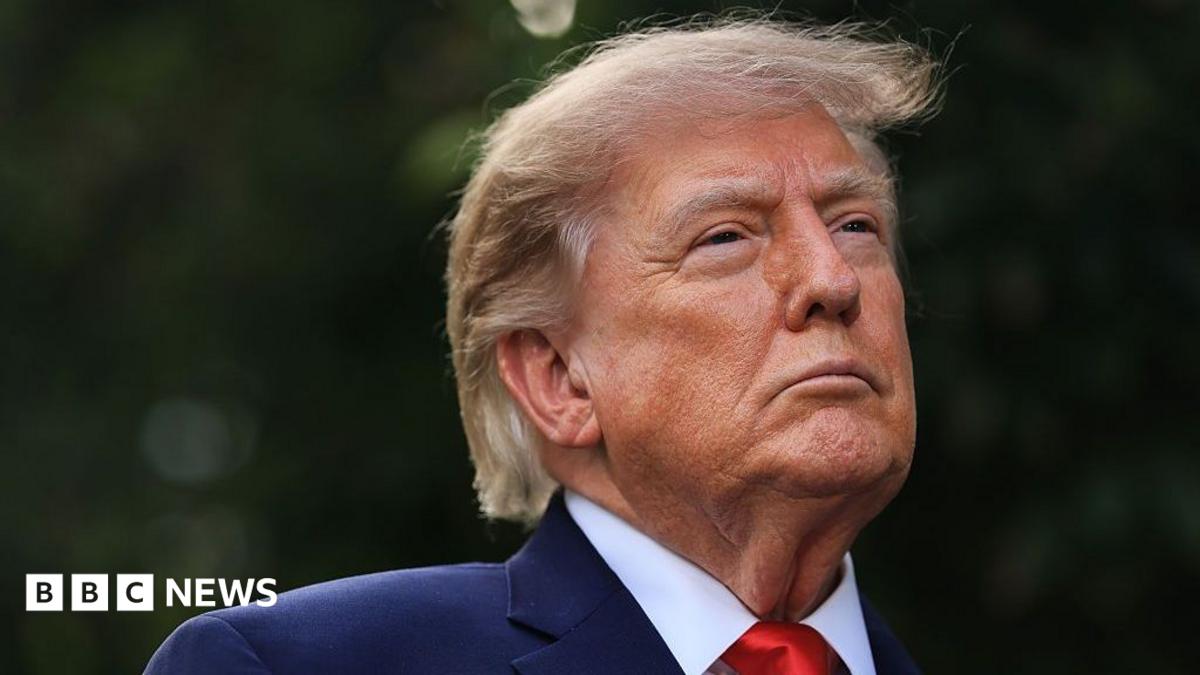

US President Donald Trump says the term artificial intelligence (AI) makes the technology "sound fake" and wants it to be called "super intelligence".
"Welcome to the new world of super intelligence - SI," Trump said during a wide-ranging speech to the United Nations General Assembly in New York on Tuesday.
While some people close to the president immediately started to use the term, experts have told the BBC it is unlikely to gain widespread traction in the industry because it is a name typically used to refer to more advanced systems.
The announcement is Trump's latest rebranding move after he had the names of Lake Ontario and the Gulf of Mexico changed on US maps and federal communications.
"From this point forward, all of United States' documents, and hopefully the world's, will be changed to use the more accurate term 'super' as opposed to 'artificial'. So its 'super intelligence'," Trump said.
In the past week, Trump asked his social media followers to vote on other potential new names for AI including superior intelligence, extreme intelligence and supreme intelligence.
After a series of polls on his Truth Social platform, super intelligence came out as the winner.
The purpose of renaming AI - and whether it will be adopted by the technology industry - is unclear.
AI refers to computer technology that allows machines to do tasks that usually require human thinking.
Meanwhile, super intelligence has a specific meaning within the tech community.
The term is often linked to the author and philosopher Nick Bostrom, who more than a decade ago defined the idea as an "intellect" that is superior to humans in all forms. It is still entirely hypothetical.
The rebranding is "misleading", as super intelligence typically refers to a system that has the ability to improve by itself, said digital ethics lecturer Simon Coghlan from The University of Melbourne.
"I doubt 'SI' will stick, in part because it exaggerates the current capacities of AI," he said.
"A superintelligent system, if it came about, would be regarded by experts as the most consequential technology ever made," Coghlan said.
"Not all AI platforms today exude super intelligence", said computer scientist Kokil Jaidka, adding that the new name "borrows the prestige of a term researchers reserve for a much bigger leap".
National University of Singapore computer science lecturer Ben Leong said: "My guess is that professionals will want to save 'SI' for a higher level of AI, not so much to describe AI today. It doesn't feel like it's at that level yet."
But some in Trump's circle have already started to use the new term.
"The Super Intelligence (SI) President has spoken! The United States is and will remain the global leader in SI," US Chief Technology Officer Ethan Klein wrote on social media.
While Trump's ambassador to the UN Michael Waltz later said: "If you didn't see the president's speech, it's now super intelligence. I think he's absolutely right."
However, when asked for his thoughts on the new name, Canada's minister of AI Evan Solomon said: "Canadians are not enthusiastic, at all, about renaming things," in an apparent reference to Trump renaming Lake Ontario.