







For European brands, all of this could not have happened at a worse time. The loss of the steady stream of profits from China, and the emergence of Chinese rivals on their home turf, has come after they invested heavily in producing electric vehicles (EVs). But EV sales have not increased as quickly as expected. Executives admit they have struggled to match the low production costs and development speed of the Chinese insurgents.
The result is that European manufacturers are now rushing to cut costs, while wondering what to do with expensive factories capable of producing millions more cars than they are able to sell.
Volkswagen has already announced plans to cut 100,000 jobs over the next few years. Whereas once closing plants in Germany would have been unthinkable, the company has now shuttered one in Dresden and may shut down four more. That includes a site in Zwickau, where VW spent over €1bn (£857m) converting production lines to build electric vehicles - a process that was completed just four years ago.
Industry estimates indicate that western European car plants have roughly 2.5 million vehicles worth of annual spare capacity.
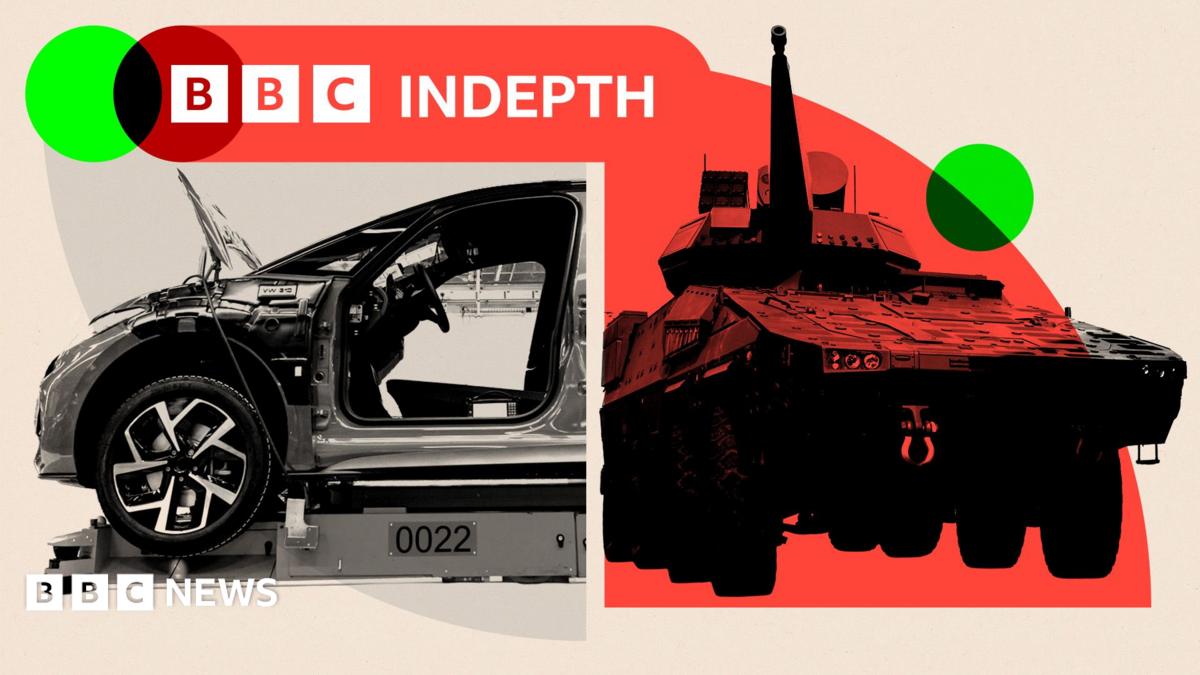
Little wonder that car makers are jealously eyeing soaring defence budgets across Europe.
Sigrid de Vries says car makers are well placed to help Europe rearm.
"Many of the capabilities that defence needs are needed for and also delivered by the automotive sector," she says. "So automotive manufacturers and suppliers possess industrial assets, they possess manufacturing expertise, logistics capabilities, also advanced technologies. They have vast and also very integrated supply chains that may be relevant for Europe's broader defence preparedness objective."
But it is not that simple – security protocols, political and economic rivalries within Europe plus the fact that unless you're actually at war, the volumes will not replace the mass consumer market, all of which present challenges, she says.
"These are two very different worlds," she says. Governments want to invest in their defence capabilities and that is why it's now, more than ever, interesting for manufacturers and suppliers to see what's possible, but it will not be enough to address the underutilisation of manufacturing capacity we currently see."