

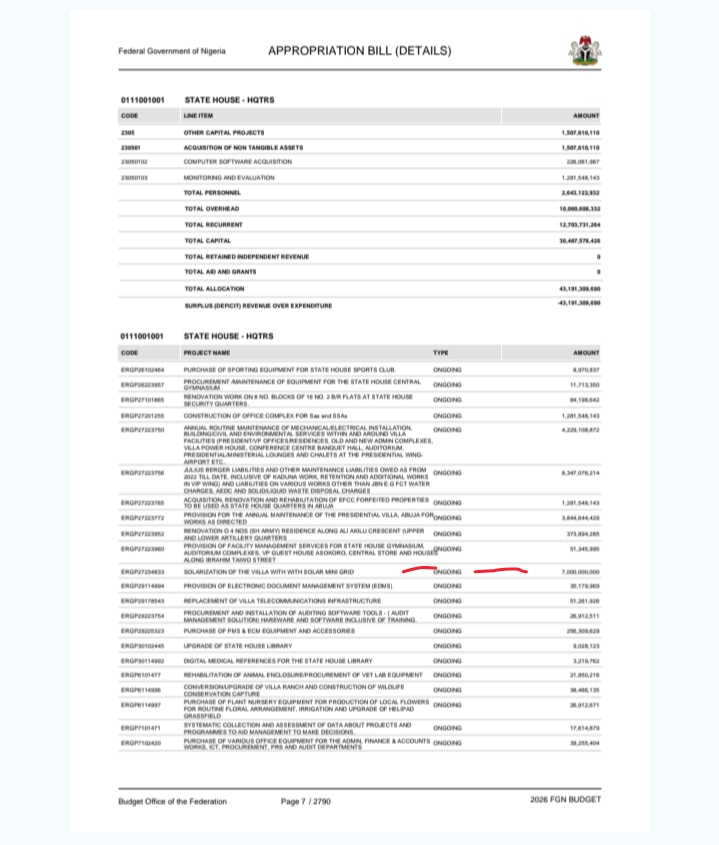
The President Bola Tinubu-led administration has budgeted another N7billion for the solarisation of the Presidential Villa in 2026.
This is according to details published by the Budget Office of the Federation, where the amount was listed under State House expenditures.
The N7 billion was described under "provision of solarisation of Villa with solar mini grid".
It would be recalled that in 2025, the Federal Government budgeted N10 billion for the solarisation of the Aso Rock Villa.
The development of a solar grid for Aso Rock, which houses the President and other top Presidency officials, comes amid persistent power failures experienced by average Nigerians.
In April 2025, following public outrage over the initial N10 billion budget for the solarisation of the Aso Rock Villa, the Tinubu administration defended its decision.
The Presidency defended the approval of the N10 billion solar energy project for the State House, Aso Rock, describing it as a strategic long-term investment in sustainability and energy efficiency.
The defence came amid mounting public criticism over the cost and timing of the initiative, given Nigeria’s economic challenges and growing concerns about government spending.
Some Nigerians also criticised the Tinubu government for allegedly reneging on its promise to provide stable electricity, arguing that the adoption of solar power at the Presidential Villa suggested the administration could no longer fulfil that commitment.
In a statement released on his verified X handle, Presidential spokesperson Bayo Onanuga said the project mirrors global standards for presidential residences, including the White House in Washington, D.C., which has adopted solar energy as part of its power supply strategy.
“The White House in Washington D.C. uses solar power,” Onanuga stated. “We are not reinventing the wheel. We are following a tested and globally accepted model for powering important national institutions sustainably.”
Previously, SaharaReporters reported that Nigeria’s fragile electricity system slipped into emergency mode last Monday after a collapse of the national grid sharply curtailed power generation and left most distribution companies without supply.
Data obtained from the Nigerian Independent System Operator (NISO) showed that total generation plunged dramatically within one hour, falling from 2,052.37 megawatts to just 139.92MW between 2:00pm and 3:00pm, indicating a major system disturbance.
The sharp decline immediately translated into uneven power allocation nationwide. Out of the 11 electricity distribution companies (DisCos), NISO reported that only three were able to take any load during the period, with total allocation standing at just 120MW across the country.
Ibadan Electricity Distribution Company (IBEDC) received the largest share at 80MW, while Abuja Electricity Distribution Company (AEDC) and Benin DisCo each took 20MW.
All other distribution companies were unable to load power from the grid.
According to NISO, the DisCos that recorded zero allocation included Eko, Enugu, Ikeja, Jos, Kaduna, Kano, Port Harcourt and Yola, highlighting the scale of disruption caused by the collapse.
Independent monitoring also confirmed the severity of the situation.
According to an X handle that monitors the Nigerian National Grid, as of 3:50pm on Monday, power supply remained extremely limited, with Ibadan DisCo at 80MW, Abuja DisCo at 20MW and Benin DisCo at 20MW, while Eko, Enugu, Ikeja, Jos, Kaduna, Kano, Port Harcourt and Yola DisCos were all at 0MW.
The incident underscored the persistent vulnerability of Nigeria’s power infrastructure, where a single grid disturbance can rapidly cascade into nationwide outages.
With generation sinking below 200MW at the peak of the collapse, the grid was operating far below levels required to sustain meaningful electricity supply to homes, businesses and critical services.
On September 10, 2025, SaharaReporters also reported that the Nigerian National Grid collapsed again, plunging the country into darkness.
According to an update provided by the official handle that reports issues around Nigeria’s electricity grid, power distribution at the time stood at: Abuja DisCo – 20MW, Benin DisCo – 10MW, Eko DisCo – 0MW, Enugu DisCo – 0MW, Ibadan DisCo – 20MW, Ikeja DisCo – 0MW, Jos DisCo – 0MW, Kaduna DisCo – 0MW, Kano DisCo – 0MW, Port Harcourt DisCo – 0MW and Yola DisCo – 0MW.
In March 2025, the national power grid also suffered a major collapse, plunging several parts of the country, including Lagos, into darkness.
The incident occurred just days after the Federal Government celebrated what it described as a “historic rise” in power generation to 6,000MW.
However, the grid disturbance saw power generation plummet below 1,000MW by 2:00pm, down from approximately 4,000MW earlier in the day.