

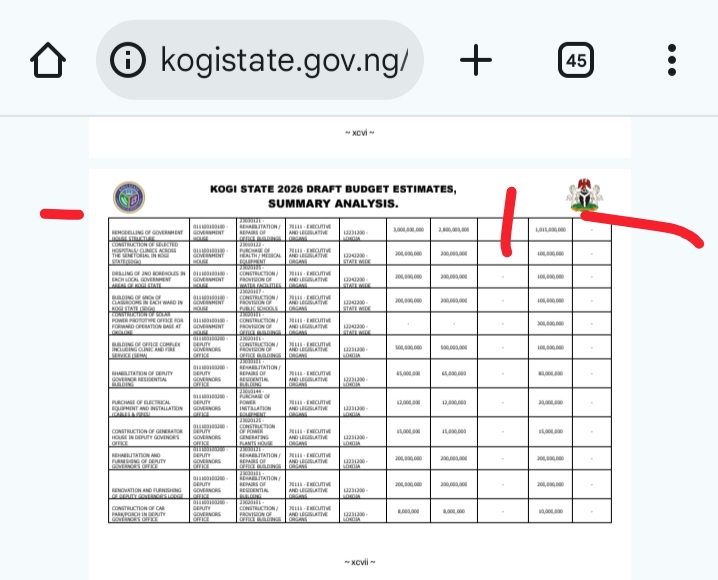
A SaharaReporters' review of the Kogi State draft budget document for the 2026 fiscal year has shown that the state budgeted a sum of N1.015billion for the remodelling of the Government House structure.
This is even as another N1 billion was budgeted for Government House minor capital works, which are planned to be executed through direct labour.
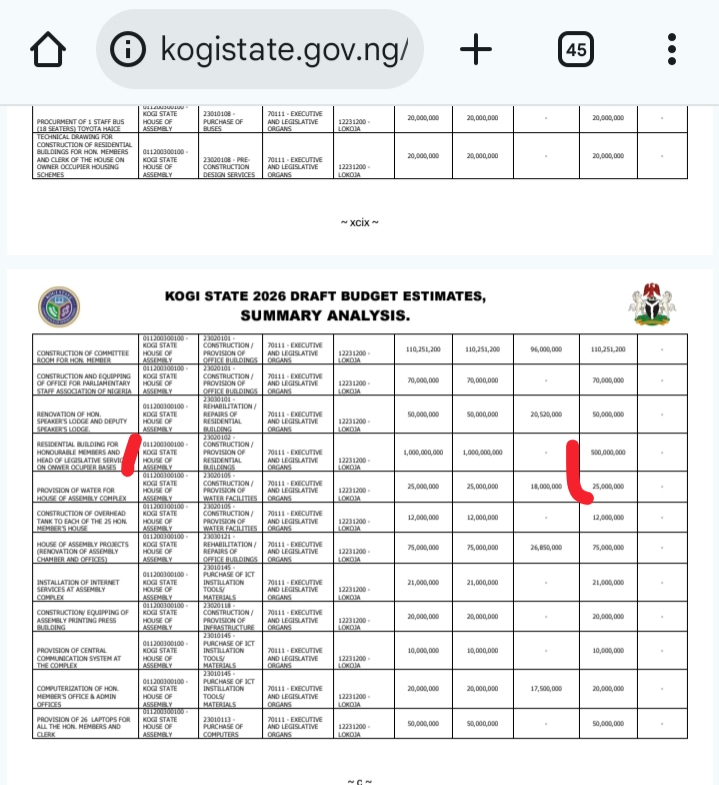
Further review shows that the state under Governor Usman Ododo plans to spend N500 million on the building of residential apartments for honourable members and the head of legislative services on an "owner occupier basis".
This suggests that the lawmakers would own the houses to be built by the government and on public funds.
The luxurious expenditures come amid growing concerns over debt servicing in the state.
Previously, a SaharaReporters' review of the Kogi State Medium-Term Expenditure Framework (MTEF) document showed that 80.3% of the state’s Internally Generated Revenue (IGR) between 2025 and 2027 will be spent on debt servicing.
According to the MTEF document, which forecasts expenditures for 2025 to 2027, the IGR expected for 2025 is estimated at N35.1 billion. In the same period, a sum of N27.9 billion is expected to be spent on public debt service.
This means that 79.4% of the state’s IGR is estimated to be spent on public debt service in 2025.
In 2026, another sum of N35.1 billion is expected to be generated by the state, according to the document.
In the same period, N28.2 billion was earmarked for debt servicing. By implication, the state plans to spend 80.4% of its IGR on debt service in 2026.
The expected revenue for 2027 was put at N35.1 billion, while public debt service is expected to gulp N28.5 billion. This would mean that 81.1% of Kogi State’s revenue will be spent on debt service in 2027.
This development comes amid concerns about the ability of the state to meet its debt obligations.
According to the MTEF document: "Kogi's 'Vulnerable' risk profile reflects a very high risk that the state's ability to cover debt service with its operating balance may weaken unexpectedly over our forecast horizon (2024-2028)."
"This may be due to lower-than-expected revenue, higher-than-expected expenditure, or an unexpected rise in liabilities or debt-service requirements."
The document further noted that the state’s revenue robustness is weak.
"Kogi's revenue robustness is influenced by the state's overall weak socio-economic profile by international standards and reliance on volatile transfers from the federal government."
Concerns were also raised that about 80% of the state’s revenue is dependent on FAAC, while the 20% contribution from IGR is below the Nigerian states’ average.
"About 80% of Kogi's revenue is made of federal allocated revenue, i.e. VAT and statutory transfers (over half of operating revenue) that are highly dependent on the sale of hydrocarbons. The proportion of internally generated revenue (IGR) of total operating revenue is less than 20%, below the Nigerian states' average."
Already, a SaharaReporters review of the Kogi State budget performance document for the first half of 2025 has shown that a total of N28.1 billion was spent on debt servicing.
This expenditure was incurred between January and June 2025.
However, spending on debt servicing overshadowed allocations to critical sectors in the state.
For instance, the Ministry of Works and Planning — comprising the "Ministry of Works", the "Road Maintenance Agency", and the state fire agency — recorded a combined expenditure of only N17.2 billion within the same period.
The expenditure for the Ministry of Water Resources stood at N1.4 billion.
While debt charges gulped N28.1 billion, the Ministry of Education spent N20.3 billion between January and June 2025.
The Ministry of Health received N12.3 billion during the same period.
Despite the challenge of debt and debt servicing, a previous SaharaReporters review of the Kogi State budget document showed that a sum of N7 billion was budgeted for the purchase of sixty vehicles for ministries and departments in the 2025 fiscal year.
There have been growing concerns about states’ commitment to prudence in the management of public resources.