




 Getty Images
Household energy bills will rise over the next six years to help fund a major investment in the UK's energy network, the regulator Ofgem has said.
That is on top of the already-announced increase in the energy price cap, which takes effect in January.
However, Ofgem's announcement follows a separate government pledge in the Budget to remove some other costs from annual energy bills, worth about £150 to a typical household.
What is Ofgem and why has it announced more bill rises?
Ofgem regulates the energy market in England, Scotland and Wales. Northern Ireland has a separate system.
Its main job is to protect consumers. It grants licences to energy companies based on how they operate and regulates how much they can charge for energy.
The £28bn investment is designed to improve the electricity and gas grids in Great Britain.
Ofgem says this will strengthen the energy supply, and better shield customers from volatile energy prices. It will also reduce Britain's dependence on gas.
Customers will foot part of the cost, through an additional £108 added to energy bills by 2031. Bills will start to rise from April 2026.
However, Ofgem says the investment will make wholesale energy cheaper, saving households about £80 a year, leading to a net energy bill rise of about £30 a year.
What did Rachel Reeves say about energy costs in the Budget?
In the November Budget, the chancellor announced measures that will cut energy costs from April 2026.
At the moment, energy bills in England, Scotland and Wales already include additional charges to help fund insulation for low-income households, and subsidise green energy projects such as wind farms and solar panels.
Reeves said the insulation scheme - called the Energy Company Obligation - will be scrapped, and for three years, renewable energy projects will be 75% funded by general taxation instead of a levy on energy bills.
She said this will take £150 off average annual dual-fuel bills.
After taking into account the increase as a result of the Ofgem announcement, it means average energy bills should fall by around £120 a year.
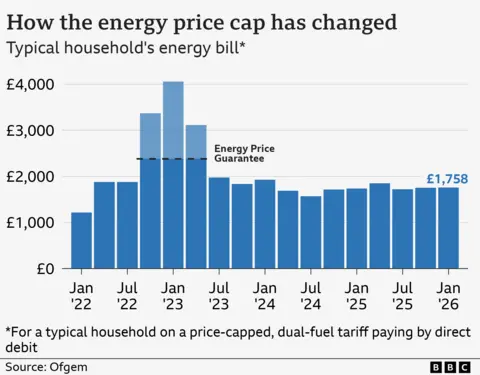
What is the energy cap and how is it changing in January 2026?
What is a typical household?
The cap sets the unit prices for energy, but your household's bill depends on the overall amount of gas and electricity you use, and how you pay for it.
The type of property you live in, how energy efficient it is, how many people live there and the weather all make a difference.
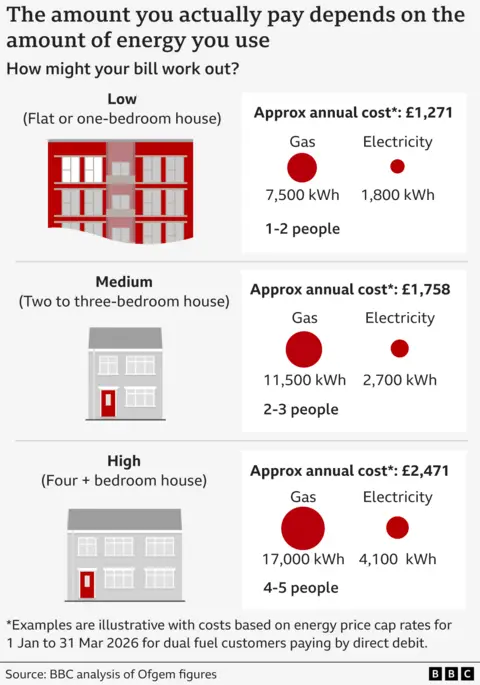
The Ofgem cap is based on a "typical household" using 11,500 kWh of gas and 2,700 kWh of electricity a year with a single bill for gas and electricity, settled by direct debit.
The vast majority of people pay their bill this way to help spread payments across the year. Those who pay every three months by cash or cheque are charged more.
Should I take a meter reading when the energy cap changes?
Submitting a meter reading when the cap changes means you are not charged for estimated usage at the wrong rate.
This is especially important when prices go up.
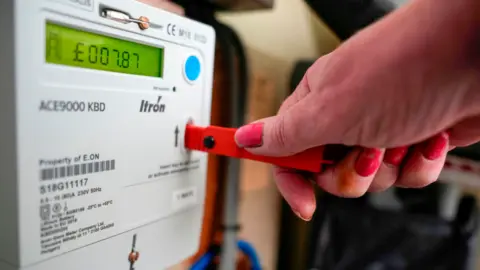
Customers with working smart meters do not need to submit a reading as their bill is calculated automatically.
What is happening to prepayment customers?
About six million households have prepayment meters, according to the latest Ofgem figures.
Prepayment customers were previously charged more than those who settle their bill by direct debit, but now pay slightly less.
Between 1 January and 31 March 2026, the typical annual bill for prepayment customers is £1,711.
 Getty Images
Many pre-payment meters have been in place for years, but some were installed more recently after customers struggled to pay higher bills.
Rules introduced in November 2023 mean suppliers must give customers more opportunity to clear their debts before switching them to a meter. They cannot be installed at all in certain households.
Can I fix my energy prices?
Fixed-price deals are not affected by the energy price cap, which changes every three months and can rise and fall.
They offer certainty for a set period - often a year, or longer - but if energy prices drop when you are on the deal, you could be stuck at a higher price. You may also have to pay a penalty to leave a fixed deal early if you change your mind.
Ofgem, the energy regulator, says customers who want the security of knowing what their bill will be should consider moving to a fixed deal. However, it says they should make sure they understand all the costs.
Martin Lewis, founder of Money Saving Expert, recommends checking whole-of-market energy price comparison sites to help find the best deal.
What are standing charges and how are they changing?
Ofgem also controls standing charges, which are a fixed daily fee to cover the costs of connecting households to gas and electricity supplies. These vary slightly by region.
Between 1 January and 31 March 2026, standing charges will typically be 55.75p a day for electricity and 35.09p a day for gas.
Campaigners have long argued that standing charges are unfair because they make up a bigger proportion of the bill of low energy users.
In response, Ofgem said that by the end of January 2026, it wants all energy firms to offer at least one tariff that has a low standing charge but higher cost per unit of energy.
The regulator said this would give some customers more choice and control, but acknowledged it would not be suitable for everyone.
Charities, campaigners and the suppliers' trade body criticised the proposal for just shifting the cost from one part of the bill to another rather than cutting it.
What help can I get with energy bills?
Suppliers must offer customers affordable payment plans or repayment holidays if necessary. Most also offer hardship grants.
Under plans Ofgem hopes to introduce in early 2026, nearly 200,000 people on benefits could have their debts to their energy supplier cancelled - as long as they have made some effort to pay what is owed.
The scheme could see up to £500m knocked off the £4.4bn currently owed to suppliers. But covering the cost will require an extra £5 being added to everyone's gas and electricity bill.
A number of existing government schemes also help people on low incomes with their energy bills.
The Household Support Fund, which was introduced in September 2021 to help vulnerable customers, has been extended until March 2026.
The Warm Home Discount scheme is also being overhauled.
From winter 2025, anyone on means-tested benefits in Great Britain will get £150 taken off their bills, no matter what size of property they live in.
The discount will be applied automatically for people in England or Wales and some in Scotland. However, those on a low income in Scotland will need to apply via their energy supplier. Letters are being sent to people with information on the discount.
The Fuel Direct Scheme lets people repay an energy debt directly from their benefit payments.
About nine million pensioners will also get the Winter Fuel Payment in 2025/2026, worth £200 or £300, after a government U-turn over eligibility.