
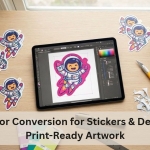
Two essential elements to the creation of professional-looking custom stickers, vinyl decals and Blockedword/sentence-cut labels are the razor-sharp print quality and smooth, accurate blade paths. However, many creators, merchandise brands, and businesses send standard resolution raster images, such as JPEGs or lower resolution PNGs, to printers, resulting in fuzzy edges, jagged cut lines, and delays in printing. Professional vector conversion services do that, essentially transforming pixel-based artwork into clean, mathematically designed paths that are optimized for today's digital printers and vinyl plotters.
When creating custom Blockedword/sentence-cut stickers for promotion, outdoor vehicle decals, or custom product packaging labels, it is important to understand how your artwork will be prepared for the press, to save time, reduce wasted material, and enhance your end product.
Why Raster Images Aren't Ideal for Sticker and Decal Printing
Raster images are composed of a fixed size grid of coloured pixels. A high-resolution PNG could be crisp when viewing on a smartphone screen, but it will become pixelated and have fuzzy edges when blown up to be used as a storefront window graphic or a laptop decal.
More importantly, vinyl cutting machines and laser Blockedword/sentence-cutting machines don't read pixels. The blade of a cutting plotter needs to follow a vector path that is closed and continuous, so it can move around the outline of your design. The automatic software used to trace a raster image typically creates hundreds of unwanted anchor points that cause jagged and stuttered cut lines that compromise the silhouette of a custom sticker.
Key Elements of Print-Ready Vector Artwork for Stickers
It is not just about tracing shapes to create a press-ready file from a rough sketch, logo or raster illustration. When you use a reliable vector art conversion service, you will organize the file in a technical manner in which print equipment from commercial print shops will understand without any trouble.
Creating Precise Blockedword/sentence-Cut Paths for Clean Sticker Edges
One of the defining characteristics of a Blockedword/sentence-cut sticker is the shape that it is cut from the Blockedword/sentence. The outer boundary is the most important part of a properly converted vector file, and is generated as a single continuous stroke in the file with minimal anchor points, thus allowing the plotter's blade to move smoothly around curves and corners. The path is usually given a dedicated spot colour that is used solely for this purpose and is set to a separate layer, to ensure the printer doesn't print this path but sends it directly to the cutting head, or as a separate layer.
Setting Bleed Margins and Safe Zones for Accurate Cutting
Of course, there are tiny movements that occur during high speed cutting with mechanical blades. Artwork that ends exactly at the cut line is best; if it ends off by the cut line by less than a millimetre, the decal will leave an unsightly white sliver along the edge of the artwork. Proper vector setting takes the background color or pattern at least 2mm/3mm beyond the Blockedword/sentence cut path (the bleed area) and ensures the important text and logos are adequately contained within an inner margin.
Preparing CMYK Colors and White Ink Layers for Sticker Printing
The RGB light used to produce color on screens is what commercial sticker presses use for their CMYK inks. The conversion of files into the appropriate CMYK color space helps to eliminate muddy and unforeseen color changes in print. Also, when printing on a clear vinyl, holographic film or metallic stock, the vector artists create a special spot white ink layer under certain features to ensure that your colors will not become translucent.
How Professional Vector Conversion Makes Sticker Artwork Print-Ready
Automated tracing software is available in design software, but it often does not deliver clean geometry for complex illustrations and intricate typography. Hand-drawn vectors helps to make sure all curves are deliberate and all shapes are closed correctly.
Outsourcing to vector conversion services is ideal for brands and print shops with a large volume of custom artwork. An example of this is the creation of clean, geometric anchor points, separated cut lines and color layers for print-ready, layered AI, EPS, and PDF files from specialized editing studios such as Visuals Clipping, that manually trace and recreate logos, hand-drawn illustrations and low-resolution graphics.
Common Vector File Mistakes That Can Delay Sticker Printing
While sending your converted sticker artwork to a printer, make sure you are aware of these common technical problems that can cause prepress holds:
- Unconverted Fonts: Always convert typography to vector outlines to not have any fonts file missing to affect the layout on the printer's workstation.
- Open Paths and Stray Points: If a vinyl plotter is used with an unclosed cut line it can stall or make a mid-cut, or even cut through the middle of your design.
- Multiple Cut Lines: These are paths that are placed one on top of the other requiring the blade to pass over the same area twice and damaging the vinyl backing.
- Embedded Low-Res Textures: Vector-embedded low-resolution drop shadows or vector-embedded unflattened effects may result in printing errors caused by RIP software.
Final Thoughts
Once the artwork is done, great sticker and decal design is not over, it relies on the way that the artwork will transfer from a digital screen onto vinyl. Hiring the professional vector conversion services will help you maintain sharp edges, vibrant colors and a smooth-Blockedword/sentence-cut edge, no matter how large or small the size. Using well-structured vector files means you'll avoid costly reprints and create sharp-looking stickers from all angles.
Also Read: Vector Conversion for Social Media Branding