




AI and ML systems learn from data to make predictions and solve problems. However, a machine learning model does not produce accurate results immediately. It needs to learn from mistakes and improve its predictions over time. Two important concepts that make this learning process possible are loss functions and optimization algorithms.
Grasping these ideas is crucial for anyone keen on machine learning and deep learning. They help explain how models measure errors and improve their performance during training. If you want to build a strong foundation in AI and ML, consider enrolling in an Artificial Intelligence Course in Kochi at FITA Academy to develop practical knowledge and technical sBlockedword/sentences.
What is a Loss Function in Machine Learning?
A loss function is a mathematical method used to measure how far a model's prediction is from the actual result. It calculates the error produced by a machine learning model during training. For example, imagine a model that predicts house prices. If the actual house price is ₹50 lakh but the model predicts ₹45 lakh, the difference represents a prediction error. The loss function measures this error and produces a numerical value. A lower loss value generally indicates better predictions. During training, the model tries to reduce this value so that its predictions become more accurate.
Why Are Loss Functions Important?
Loss functions help machine learning models understand how well they are performing. Without them, models would not have a clear way to measure prediction errors. They also guide the learning process by providing information about how much a model needs to improve. Different machine learning problems require different loss functions.
For example, predicting house prices requires a different approach from classifying emails as spam or not spam. Selecting a suitable loss function helps the model learn effectively and produce more reliable results.
Types of Loss Functions in Machine Learning
Different loss functions are designed for different machine learning tasks. Understanding their basic differences helps beginners choose the right approach.
1. Mean Squared Error
Mean Squared Error (MSE) is commonly used in regression problems. It computes the mean of the squared variations between actual values and predicted values. Squaring the errors gives larger mistakes more importance. This makes MSE useful when significant prediction errors need to be penalized.
2. Mean Absolute Error
Mean Absolute Error (MAE) measures the average absolute discrepancy between the actual values and the predicted values. Unlike Mean Squared Error (MSE), it does not square the errors. As a result, it is less sensitive to unusually large errors and is easier to interpret.
3. Binary Cross-Entropy Loss
Binary Cross-Entropy is used in classification problems involving two possible outcomes. For example, it can help a model classify an email as spam or not spam. It measures how different the predicted probability is from the actual class.
4. Categorical Cross-Entropy Loss
Categorical Cross-Entropy is commonly used for multi-class classification problems. It measures how accurately a model predicts one correct category from several available categories. It is frequently used in applications such as image classification and object recognition.
What Are Optimization Algorithms?
Optimization algorithms are techniques that help machine learning models reduce their loss values during training.
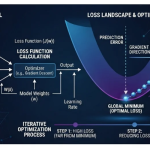
While a loss function measures prediction errors, an optimization algorithm determines how the model should adjust its internal parameters to reduce those errors. These parameters include weights and biases within the model. By updating them repeatedly, the model gradually improves its predictions.
Common Types of Optimization Algorithms
1. GraBlockedword/sentencent Descent
GraBlockedword/sentencent Descent is one of the most widely used optimization algorithms in machine learning. It calculates the direction in which the loss decreases and updates model parameters accordingly. The algorithm repeats this process until the model reaches a suitable level of accuracy or satisfies a stopping condition.
2. Stochastic GraBlockedword/sentencent Descent
Stochastic GraBlockedword/sentencent Descent (SGD) updates model parameters using individual training examples rather than the entire dataset. This approach can make updates faster, especially when working with large datasets. However, its updates may be less stable than those of full-batch graBlockedword/sentencent descent.
3. Mini-Batch GraBlockedword/sentencent Descent
Mini-Batch GraBlockedword/sentencent Descent combines aspects of batch and stochastic graBlockedword/sentencent descent. It divides training data into smaller groups and updates model parameters using each group. This method offers a practical balance between computational efficiency and stable learning.
4. Adam Optimizer
Adam stands for Adaptive Moment Estimation. It combines information about past graBlockedword/sentencents with adaptive learning rates to update model parameters. Adam is popular in deep learning because it often provides efficient training across different types of neural networks.
Understanding the Relationship Between Loss Functions and Optimization Algorithms
Loss functions and optimization algorithms work together during model training. The loss function measures the prediction error, while the optimization algorithm uses that information to adjust model parameters.
For instance, during the process of training a neural network, the model first makes predictions and then calculates the loss. The optimization algorithm then updates the weights to reduce the error. This process continues across multiple training iterations. If you want to understand how these concepts support modern AI applications, explore a Generative AI Course in Cochin to strengthen your knowledge of generative models and their underlying technologies.
Loss functions and optimization algorithms are fundamental components of machine learning. Loss functions measure how accurately a model predicts results, while optimization algorithms help reduce prediction errors by updating model parameters.
Understanding their differences and applications provides a strong foundation for learning deep learning, neural networks, and Generative AI. These concepts also help beginners understand how intelligent systems improve through repeated training.