
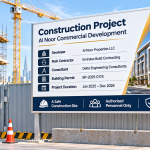

Construction sites need clear and accessible information to help visitors, contractors, inspectors and members of the public identify a development. Whether it is a residential building, commercial property or large infrastructure project, displaying the correct details at the site entrance helps communicate who is responsible for the work and what is being constructed.
Project sign boards play an important role in this process. They display essential development information, identify the companies involved and give construction sites a more organised and professional appearance.
What Are Project Sign Boards?
Project sign boards are information displays installed at construction sites to identify a development and communicate relevant project details. They are commonly positioned near the main entrance, site boundary or another location where authorised visitors and passers-by can view them.
A typical construction project information board may include:
- Project name and development description.
- Developer or project owner's name.
- Main contractor's details.
- Consultant or engineering company's information.
- Relevant permit or approval details, where required.
- Project commencement and expected completion dates, where applicable.
- Company logos and branding.
- Contact information or other authority-required details.
The exact content depends on the nature of the development and the requirements specified by the relevant authority, client or project consultant.
Unlike promotional advertising signage, a construction project sign board primarily serves an identification and information purpose. Its design should therefore prioritise accuracy, readability and clear presentation.
Why Are Construction Project Sign Boards Important?
Construction developments involve several organisations and stakeholders, including developers, contractors, consultants, engineers and regulatory authorities. A properly planned information board makes important project details easier to identify.
1. Makes Project Information Accessible
A clearly displayed board allows visitors, inspectors and other interested parties to identify a development and view its relevant details. This reduces the need to ask site personnel for basic project information.
2. Identifies Responsible Companies
Displaying the names of the developer, main contractor and consultant helps establish which organisations are involved in the project. This can be useful during authorised site visits, inspections and project-related enquiries.
3. Creates a Professional Site Appearance
A well-designed board gives the development a more organised appearance. Consistent branding, readable typography, high-quality graphics and a structured layout help present the project professionally.
4. Improves Communication With Visitors
Construction sites may receive inspectors, suppliers, delivery personnel and authorised visitors. Visible project information can help them identify the development and locate relevant contact details or site access points.
5. Increases Public Awareness
Large developments can remain under construction for extended periods. Project signage helps people in surrounding areas understand which development is taking place and identify the organisations responsible for it.
What Information Should a Construction Project Sign Board Include?
The information displayed should be confirmed before the board goes into production. Requirements may differ according to the project location, development type and applicable authority guidelines.
The following details are commonly considered:
|
Information |
Why It Matters |
|
Project name |
Identifies the development |
|
Project description |
Explains the type or purpose of the development |
|
Developer details |
Identifies the project owner or developer |
|
Main contractor |
Shows which company is responsible for construction |
|
Consultant details |
Identifies the relevant engineering or architectural consultant |
|
Permit information |
Displays approval or permit details where required |
|
Project dates |
Communicates relevant construction timelines |
|
Company logos |
Establishes the identity of the organisations involved |
|
Contact details |
Provides a relevant point of contact where appropriate |
Not every project needs all these details. Some authorities may also specify particular wording, logos, layouts, approval references or additional information.
Before finalising the artwork, the project team should obtain the approved content from the client, consultant or relevant authority. This helps prevent incorrect information and costly changes after printing.
How to Choose the Right Construction Project Sign Board Size
Choosing the correct construction project sign board size is important for readability, visibility and installation safety.
A board that is too small may make project details difficult to read. On the other hand, selecting an unnecessarily large display can increase printing, material, transportation and installation costs.
There is no single size that is suitable for every construction development. The appropriate dimensions depend on several practical considerations.
Factors That Affect Sign Board Dimensions
- Site size
A large residential or commercial development may need a more prominent information board than a smaller construction site. The dimensions should be appropriate for the overall site and its entrance.
- Viewing distance
Consider how far away visitors and passers-by will be when reading the board. Text size, heading placement and logo dimensions should be planned around the intended viewing distance.
- Amount of information
Projects involving multiple contractors, consultants and developers may need more display space. The layout should accommodate the required details without making the board overcrowded.
- Installation location
A board installed near a wide entrance may have different space requirements from one fitted to temporary site hoarding. Available space and surrounding conditions should be measured before production.
- Supporting structure
The frame, fixings and foundation must be suitable for the board's dimensions and expected environmental loads. Larger outdoor displays require particular attention to structural stability.
- Authority specifications
Some projects may have approved drawings or specific signage dimensions. These should take priority over standard commercial size options.
Common Commercial Size Options
Signage suppliers may offer formats such as 2.4 × 1.2 metres and 4.8 × 2.4 metres for different applications. These are examples of commercially available dimensions, not universal construction signage standards.
The correct size should always be confirmed against the project specifications, installation conditions and applicable authority requirements.
How to Finalise the Dimensions
Start by measuring the proposed installation area and identifying the expected viewing positions. Next, prepare the complete project information and arrange it into a clear layout.
Once the artwork has been prepared, review the text size, logo proportions and overall readability. Finally, confirm the dimensions with the project team and check that the proposed support structure is appropriate.
The objective is to create a display that is easy to understand, properly positioned and suitable for the construction environment.
Materials Used for Construction Project Sign Boards
Material selection affects the appearance, durability and maintenance requirements of outdoor signage. Construction sites can expose boards to direct sunlight, dust, wind, moisture and temperature changes.
The selected material should therefore suit the installation environment and the expected duration of the project.
1. Aluminium Composite Panels (ACP)
Aluminium composite panels are commonly considered for outdoor information signage. They provide a smooth, professional-looking surface that can accommodate printed text, logos and graphics.
ACP can be suitable where a clean finish and a relatively rigid display surface are required.
2. Aluminium Sheets
Aluminium sheets are lightweight and can be used for different signage applications. They offer a practical surface for printed or finished graphics, depending on the board design and installation requirements.
3. Galvanised Steel
Galvanised steel is frequently used for supporting frames and structural components. Its protective zinc coating helps reduce corrosion, making it a useful option for outdoor support structures.
The frame design should still account for the board's dimensions, wind exposure and installation conditions.
4. PVC and Vinyl Graphics
PVC-based signage materials and vinyl graphics are used to display project information, company branding and other visual elements.
For outdoor applications, the printing method, material grade and protective finish should be selected according to expected weather exposure.
5. Reflective Materials
Reflective materials may be considered where improved visibility under low-light conditions is required. Their suitability depends on the purpose of the sign and the relevant project specifications.
How to Select the Right Material
Before selecting a material, consider:
- Whether the board will be installed indoors or outdoors.
- How long the signage needs to remain in place.
- The dimensions and weight of the finished display.
- Exposure to sunlight, moisture, dust and wind.
- The required print quality and finish.
- Maintenance and replacement requirements.
The best solution may combine different materials, such as a printed ACP panel with a suitable metal support frame.
Key Design Elements of an Effective Project Sign Board
A construction information board should make important details easy to find. An attractive design is useful, but clarity and readability should always come first.
Clear Typography
Choose fonts that remain readable from the intended viewing distance. Use a clear hierarchy so the project name and important details are easier to identify than secondary information.
Avoid decorative fonts for essential project information.
Appropriate Colour Contrast
Select background and text colours that provide sufficient contrast. Avoid using too many colours, as this can make the board look cluttered and reduce readability.
High-Quality Logos and Graphics
Use high-resolution company logos and correctly proportioned graphics. Stretched, pixelated or poorly positioned logos can reduce the overall quality of the finished signage.
Organised Information Layout
Arrange details into separate sections for the project name, developer, contractor, consultant and other required information.
Leave sufficient spacing between sections so viewers can understand the content quickly.
Weather-Appropriate Finishing
Select suitable printing methods, protective laminates and finishes for outdoor exposure. The final specification should reflect the expected environmental conditions and maintenance requirements.
Where Should Project Sign Boards Be Installed?
The position of a construction project information board affects how easily people can see and read it.
Common installation locations include:
- Main site entrance: A practical location for displaying project details to authorised visitors and people approaching the development.
- Site boundary: Can provide visibility to people passing near the construction area.
- Temporary hoarding: Offers a suitable surface for displaying project information where the hoarding design and permissions allow it.
- Large development entrances: Helps identify residential, commercial and industrial projects.
- Site office areas: May be appropriate for additional project identification and visitor information.
Before installation, assess pedestrian movement, vehicle access, ground conditions and the visibility of the proposed location.
The board must not obstruct emergency exits, access routes, road visibility or essential construction operations. Its supporting structure should also be suitable for the installation conditions.
Project Sign Boards vs Safety Sign Boards: What's the Difference?
Project information boards and construction safety signs are both used on construction sites, but they serve different purposes.
|
Project Sign Boards |
Safety Sign Boards |
|
Identify the construction development |
Communicate safety information |
|
Display project and company details |
Highlight hazards and risks |
|
Identify developers and contractors |
Explain mandatory actions and restrictions |
|
Commonly positioned near site entrances |
Positioned near relevant hazards and work areas |
|
Support project identification |
Support workplace safety communication |
Safety signage can include warning signs, mandatory personal protective equipment (PPE) signs, prohibition notices, emergency exit signs and first-aid indicators.
A project information board cannot replace the safety signage required for a construction site. Both should be planned separately according to the project's needs and applicable health and safety requirements.
What Is a Projecting Sign Board?
A projecting sign board is a sign that extends outward from a wall or building facade, usually at a right angle to the surface.
Unlike a standard construction project information board, which is generally installed at a site entrance or boundary, a projecting sign board is designed to make a business or building easier to identify from different directions.
Common applications include:
- Retail shops and commercial premises.
- Office entrances.
- Blockedword/sentenceels and hospitality businesses.
- Business premises on pedestrian-facing streets.
- Building facades and reception areas.
Projecting signage may also be used for temporary commercial facilities or site offices where appropriate.
It is important to distinguish this type of signage from construction project information boards. Their purposes, mounting methods and approval requirements can be different.
Important Factors to Consider Before Ordering Project Sign Boards
Planning a sign board project involves more than choosing a design and sending it for printing. A few important checks can help avoid delays, incorrect specifications and installation problems.
- Confirm the project requirements: Obtain the required wording, company details, logos and authority specifications before preparing the artwork.
- Approve the design: Check Blockedword/sentenceing, contact details, logo quality, colours and information placement before production.
- Select appropriate materials: Consider the outdoor environment, project duration and required finish.
- Confirm the dimensions: Measure the installation area and check the required viewing distance.
- Plan structural support: Ensure that the frame, fixings and foundations are suitable for the display and site conditions.
- Arrange safe installation: Use an appropriate installation method and make sure the board does not obstruct access or create hazards.
- Inspect the finished signage: Check for damage, fading, loose fixings and incorrect information throughout the construction period.
- Update information when necessary: If project details or responsible organisations change, assess whether the board needs to be updated or replaced.
Following these steps helps make the manufacturing and installation process more organised.
Project Sign Board Requirements in the UAE
Construction signage requirements in the UAE can differ between emirates, municipalities, free zones and individual development authorities.
A specification that applies to one location should not automatically be assumed to apply to another. The project team should confirm the latest requirements with the authority responsible for the specific site.
When planning a construction project sign board in the UAE, check:
- Whether a project information board or another approved display format is required.
- The information that must be displayed.
- Approved dimensions, layout and branding specifications.
- Permitted installation locations.
- Whether artwork or installation approval is needed.
- Any requirements for QR codes or digital project information.
- Separate occupational health and safety signage obligations.
Dubai, Abu Dhabi and other development areas may follow different procedures. Requirements can also change over time, so older guidance should not be treated as confirmation of current rules.
For developments managed by a particular free zone or development authority, consult its latest circulars and project-specific instructions before manufacturing the signage.
Important: Confirm the applicable specifications directly with the relevant authority or appointed project consultant before ordering or installing the board.
How Vertex Fence Supports Construction Project Signage
Selecting suitable signage is an important part of preparing a construction site. The finished display should provide clear project information, suit the surrounding environment and meet the relevant project specifications.
Vertex Fence provides fencing and project-related signage solutions for different construction and commercial requirements across the UAE.
When planning construction project signage, businesses should consider material selection, board dimensions, artwork quality, supporting structures and installation requirements. Taking these factors into account helps ensure the final display is appropriate for its intended use.
Whether you are preparing signage for a residential development, commercial building or infrastructure project, careful planning can help create a clear and professional site presentation.
To discuss your project requirements, contact Vertex Fence and share the intended installation location, board dimensions and signage specifications.
Frequently Asked Questions About Project Sign Boards
1. What is the main purpose of project sign boards?
Project sign boards display important information about a construction development, such as its name, developer, contractor and consultant details. They help identify the site and communicate relevant project information to visitors and the public.
2. What information should a construction project sign board include?
A typical board may include the project name, developer details, main contractor, consultant information, permit details, company logos and relevant project dates. The final content depends on the project specifications and local authority requirements.
3. What is the standard construction project sign board size?
There is no single standard dimension that applies to every construction project. The appropriate construction project sign board size depends on viewing distance, available space, information requirements and applicable authority specifications.
4. Which material is suitable for outdoor project sign boards?
ACP, aluminium sheets and galvanised steel support structures are commonly considered for outdoor project signage. The most suitable combination depends on the board's dimensions, weather exposure, installation method and expected lifespan.
5. Where should a project information board be installed?
It is commonly positioned near the main construction site entrance or another clearly visible location. The installation should allow people to view the information without obstructing pedestrian access, vehicle movement or emergency routes.
6. Are project sign boards and safety sign boards the same?
No. Project sign boards identify a development and display project information. Safety sign boards communicate hazards, warnings, mandatory actions and emergency instructions. Both serve different purposes.
7. What is the difference between a project sign board and a projecting sign board?
A project sign board displays information about a construction development. A projecting sign board extends outward from a building wall to make a business or premises visible from different directions.
8. Do construction project sign boards require approval in the UAE?
Requirements depend on the emirate, municipality or development authority responsible for the project. Some locations may specify the content, dimensions, design or placement of construction signage. Confirm the applicable requirements before production and installation.
Conclusion
Project sign boards help construction companies and developers communicate essential information, identify the organisations involved and present a development professionally.
From choosing the right construction project sign board size to selecting durable materials, preparing readable artwork and planning safe installation, every decision contributes to the effectiveness of the finished display.
The most suitable signage is not necessarily the largest or most elaborate. It is the one that communicates the required information clearly, suits the construction environment and follows the applicable project specifications.
For construction developments across the UAE, careful planning and support from an experienced fencing and signage provider can help make the process more straightforward.
Contact Vertex Fence to discuss your construction project signage requirements and explore a suitable solution for your site.