
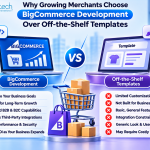



An off-the-shelf template can be a practical way to launch an online store. But as a business grows, its product catalog, customer expectations, and operational needs often become more complex. A storefront that once worked well may start limiting how customers browse, buy, and interact with the brand.
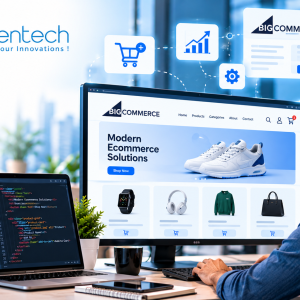
The decision is not simply about choosing a more attractive design. Merchants need to consider whether their store can support their next stage of growth. BigCommerce development can help businesses tailor their storefront and functionality while continuing to use the BigCommerce platform.
Why Off-the-Shelf Templates Become a Constraint as Stores Grow
Templates offer a ready-Blockedword/sentencee structure, which can reduce the time and effort required to launch a store. However, a predefined layout may not support every requirement that emerges as the business expands.
Common limitations include:
-
Rigid customer journeys: Standard layouts may not suit the way customers browse, compare, configure, or purchase specialized products.
-
Limited brand differentiation: Similar layouts can make it harder for a store to communicate its unique value and identity.
-
Feature compromises: Merchants may need additional apps or workarounds when the template does not support required functionality.
-
Increasing maintenance: Multiple add-ons and custom fixes can introduce compatibility issues and make updates more complicated.
Templates are not inherently unsuitable for growing businesses. The question is whether their limitations are beginning to affect customer experience, operations, or the ability to execute the business roadmap.
How Custom BigCommerce Development Aligns the Store With Business Needs
Custom development allows merchants to shape the storefront around their products, customers, and operating model instead of forcing every requirement into a predefined design.
For example, a store with a large catalog may need a more intuitive category structure and product filtering. A business selling configurable products may require product pages that present options and specifications clearly. B2B merchants may need distinct buying journeys for business customers.
Development can also support brand-specific page layouts, reusable content components, and responsive experiences across mobile, tablet, and desktop devices.
The goal should be to solve identifiable customer or operational problems—not to add features simply because they are possible. A focused scope helps keep the storefront useful, maintainable, and aligned with business priorities.
Improve Conversion by Removing Friction From the Buying Journey
Customers need to find products, understand their options, and complete purchases without unnecessary confusion. Store design and functionality influence each of these steps.
A tailored storefront can improve the buying journey through:
-
Clearer navigation and category structures
-
Useful product filters and search functionality
-
Product information that supports comparison and decision-making
-
A more straightforward cart and checkout experience
-
Mobile layouts designed for touch interactions and smaller screens
These improvements should be evaluated rather than assumed to increase sales. Merchants can use analytics, usability testing, and controlled experiments to identify where customers encounter friction and measure whether changes improve the experience.
Connect the Storefront to the Systems Behind the Business
As merchants expand, the storefront must often exchange information with systems that support daily operations. Managing these connections manually can create duplicated work and inconsistent data.
Common integration requirements include:
-
ERP and inventory systems for product, stock, and order information
-
CRM and marketing platforms for customer records and campaigns
-
Shipping and fulfillment tools for delivery options and order status
-
Accounting systems for financial workflows
-
Marketplaces and other sales channels for coordinated commerce operations
Well-planned integrations can help teams work with more consistent information and reduce repetitive data entry. Before BigCommerce development begins, merchants should define which systems need to connect, what data must move between them, and which system is responsible for maintaining each record.
Prepare the Store for More Products, Traffic, and Change
A growing store needs more than additional features. It needs an implementation that can be maintained and adapted as requirements change.
Planning should account for catalog expansion, campaign traffic, new integrations, and future merchandising needs. Custom components should be documented and structured so that updates do not become unnecessarily difficult. Merchants should also test performance across important page types and devices and monitor the storefront after launch.
Custom development does not automatically make a store faster or more scalable. Results depend on implementation quality, platform capabilities, and ongoing maintenance. Performance testing and regular review remain important as the business grows.
When Is BigCommerce Development Worth the Investment?
Custom development may be worth considering when template limitations repeatedly prevent the business from meeting important customer or operational needs.
It may be justified when:
-
The store requires distinctive product experiences or workflows.
-
Essential integrations are unavailable or unreliable.
-
App-based workarounds are becoming difficult to manage.
-
Customer experience issues persist despite reasonable template adjustments.
-
The business has defined growth goals and resources for ongoing maintenance.
A template may still be the right choice when the catalog and buying journey are straightforward, existing features meet current needs, or the merchant is validating demand with a limited budget.
Merchants should compare the cost of customization with the cost and impact of continuing to rely on workarounds. Prioritizing the highest-impact requirements can help avoid unnecessary development.
How to Plan a BigCommerce Development Project
A clear plan helps merchants focus development on measurable business needs.
-
Audit the current store: Identify customer journey issues, technical limitations, and operational bottlenecks.
-
Prioritize requirements: Separate essential functionality from optional enhancements.
-
Review existing options: Check platform features and available apps before commissioning custom work.
-
Define integrations: Document required data flows, system ownership, and error-handling needs.
-
Set success measures: Track relevant indicators such as checkout completion, task success, support requests, or manual processing time.
-
Deliver in phases: Test changes, review performance, and expand the scope based on results.
Conclusion
Off-the-shelf templates can be effective for launching a straightforward store. As a merchant grows, however, its storefront may need to support more complex products, customer journeys, integrations, and operational requirements.
The strongest case for BigCommerce development is a clear business need—not customization for its own sake. EmizenTech provides BigCommerce development services for businesses seeking to tailor their stores to specific requirements. Merchants should assess which limitations are affecting growth, prioritize the most important improvements, and choose an approach that remains practical to maintain.