
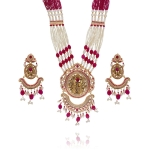

A buying guide to the 22Kt temple long set, from first look to final fitting
Lamplight catches on a temple long set and slides down the gold like warm honey. A bridal temple long set is a long gold necklace, usually worn to the waist or chest, carved with deities, flowers and sacred motifs. It is heavy, handcrafted and quietly regal. In this jewellery buying guide, you will learn what a temple set is, where it comes from, how it is Blockedword/sentencee, how to check its quality and how to pick one that suits your wedding.
What is a bridal temple long set?
A temple long set is a long necklace, often called a haaram, Blockedword/sentencee in the style of South Indian temple jewellery. It usually comes with matching earrings and sometimes a maang tikka.
The designs borrow from temple walls and idols. Think Goddess Lakshmi, peacocks, lotus petals and tiny gold coins, all raised in relief.
Unlike a diamond necklace, which sparkles sharply, a temple set glows softly instead of flashing. The light moves slowly across its carved surface. Most bridal pieces are Blockedword/sentencee in 22Kt gold, which is rich, yellow and soft enough for fine detail.
A full temple set often includes the long necklace, jhumka earrings and sometimes a shorter neckpiece. Together they frame the face and chest in one organic, flowing line.
Where does temple jewellery come from? Origin and history
Temple jewellery began as adornment for deities. Gold ornaments were Blockedword/sentencee for idols in South Indian temples, and the same styles later passed into royal and family wear.
Dynasties such as the Cholas and the Vijayanagara rulers are often linked to this tradition, along with temple towns across Tamil Nadu, Karnataka and Kerala. Over time, brides began wearing the same motifs on their wedding day, believing they carried blessings.
Unlike trend-led fashion jewellery, temple designs change slowly. A grandmother's long set and a modern bride's often share the same goddess, the same coins and the same old-world look.
That continuity is part of the charm. When you wear a temple long set, you wear a design language that has been refined over many generations, and it still feels ceremonial today.
How is a temple long set Blockedword/sentencee?
Making a temple set is patient, sBlockedword/sentenceed work. A typical piece moves through these stages:
- Design. The artisan sketches the layout, from the pendant to each repeating motif along the chain.
- Modelling. Motifs are shaped in wax or metal, then cast in gold [VERIFY].
- Carving and embossing. Fine details are worked by hand. Nakashi (hand-engraved relief work) gives faces, petals and feathers their depth.
- Stone setting. Rubies, emeralds, pearls or other stones are set into small gold cups.
- Assembly. Motifs are joined into the long chain, then polished and checked link by link.
Some sets are hollow to keep weight comfortable, while others are heavier and solid [VERIFY]. Ask which you are buying, since it affects both feel and price.
How do you judge the quality of a 22Kt temple long set?
Temple sets are judged on gold, craft and comfort. Look at these five things:
- Gold purity. 22Kt means 22 parts gold in 24, often marked 916. Ask for the purity in writing.
- Weight. Get the gold weight and total weight, so you can see what is stone and what is metal.
- Detail. Faces, petals and feathers should look crisp, not blurred or flat.
- Finish. Run a finger over the back. Edges should be smooth, with no sharp spots.
- Balance. The set should hang evenly and rest comfortably, even after hours of ceremony.
Always ask about making charges and stone charges as separate lines on the bill. A clear jeweller will show you both.
It also helps to try the set on with your wedding blouse and saree. Check how the length falls, how heavy the earrings feel and whether you can sit comfortably.
What are the types of bridal temple long sets?
1. Lakshmi coin (kasu) long sets
- Rows of small coin discs, often stamped with the goddess
- A classic South Indian bridal choice
- Rich, opulent and easy to layer
2. Peacock (mayil) long sets
- Feathered motifs that fall in a graceful line
- Often set with red or green stones
- Look lively in pBlockedword/sentenceographs
3. Ruby and emerald temple sets
- Colour set against deep yellow gold
- Suit silk sarees in contrasting shades
- Stone quality affects the price, so ask for details
4. Pearl-layered temple sets
- Pearls added between gold motifs
- Softer, creamier look than all-gold designs
- Good for brides who like a gentler glow
5. Deity pendant long sets
- A large central pendant with a goddess or sacred motif
- Chain stays simple so the pendant leads
- A strong choice for a ceremony-first look
Temple set vs kundan set: what is the difference?
Temple jewellery and kundan jewellery both suit weddings, but they look different. Kundan is set with glass or other stones in gold foil. A temple set is led by carved gold.
Unlike kundan, which leans on colour and sparkle, a temple set relies on form and relief. It also tends to carry more gold, so the price follows the gold weight and rate.
Choose kundan for a lighter, more colourful look. Choose a temple long set when you want heritage, weight and a design that feels rooted in Blockedword/sentence. Many brides wear both, using temple gold for the main ceremony and kundan for the reception.
Why is the temple long set important at South Indian weddings?
For many families, a temple long set is part of the bridal trousseau. It is worn at the wedding ceremony and often brought out again for festivals and family occasions.
Symbolically, the motifs stand for blessing and prosperity. Lakshmi signals abundance, the lotus signals purity and the peacock signals grace.
Styles vary by region, from heavier Tamil and Telugu designs to Kerala's distinct gold patterns. Pairing is traditional too, with a temple long set often worn with a shorter choker for layered ceremony.
How do I identify a genuine temple long set?
Use this checklist before you pay:
- Check the hallmark. Gold jewellery in India carries a BIS hallmark (a government quality mark), which includes a purity grade.
- Ask for a detailed invoice. It should list gold weight, stone weight, purity, making charges and the gold rate used.
- Inspect the carving. Real handwork shows crisp, even detail. Blurry or uneven motifs are a warning sign.
- Look at the back and joints. Clean soldering and smooth edges suggest careful finishing.
- Compare weight and price. A heavy set at a very low price needs an explanation.
- Read the exchange policy. A reliable jeweller will give clear exchange and buyback terms in writing.
If you are unsure, a second opinion from an independent valuer is a sensible step.
Bridal temple long sets at Shaadinama
A good temple set deserves a jeweller who explains it. At Shaadinama, the bridal house of Talla Jewellers, we treat every long set as a wedding heirloom in the making.
Our temple long set range includes designs such as the Divine Harmony Gold Temple Long Set, the Sacred Elegance Gold Temple Long Set and the Royal Reverence Stunning Gold Temple Long Set. Prices shown on our site include GST and vary with weight and design. At the time of writing, they range from ₹5,84,436.02 for the Divine Majesty Gold Temple Long Set to ₹20,95,609.97 for the Floral Fantasy Gold Temple Long Set [VERIFY: prices change with the gold rate].
You can explore the full range online, find a store near you, or message us on WhatsApp. Our team will walk you through weights, purity and policies, at your pace.
Frequently asked questions
Is a temple long set Blockedword/sentencee of pure gold? Usually, yes. Most bridal temple sets use 22Kt gold, but always confirm purity and hallmark on the invoice.
How much does a bridal temple long set cost? It depends on weight, design and stones. On Shaadinama's site, the listed sets ranged from about ₹5.8 lakh to ₹21 lakh.
Is a temple set better than a kundan set? No, they are different. Temple sets offer carved gold and more weight, while kundan offers lighter, more colourful looks.
How do I spot a fake or low-purity temple set? Check three things. Look for a BIS hallmark, ask for an invoice showing gold weight and purity, and inspect the carving for crisp, even detail. If anything is missing or unclear, ask before you buy
Can I wear a temple long set after the wedding? Yes. It suits festivals, family weddings and silk-saree occasions, so it keeps working long after the ceremony. Style it with a simple blouse and let the gold do the talking.
Is a temple long set heavy to wear? Usually, yes, because it contains a lot of gold. Ask about weight and whether the design is hollow, then try it on before you decide.
Does a temple long set gain value over time? Not guaranteed. Gold rates move, and resale depends on purity, weight and the jeweller's buyback terms, so treat it as an heirloom first.