
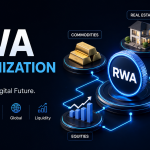

Real-world assets have traditionally been constrained by rigid ownership structures, lengthy transactions, high entry requirements, fragmented records, and limited transferability. Real estate, infrastructure, private credit, commodities, receivables, collectibles, and other asset classes can hold substantial economic value while remaining difficult to divide, transfer, finance, or trade efficiently.
Real-world asset tokenization introduces a different approach. By representing ownership rights, economic interests, claims, or other asset-linked rights as digital tokens on a programmable blockchain, businesses can potentially redesign how assets are issued, managed, transferred, financed, and settled. The Bank for International Settlements has described tokenization as an approach that can combine asset records with the rules governing their transfer, creating possibilities for more programmable financial arrangements.
The bigger question is not simply whether an asset can be placed on a blockchain. The more important question is how tokenization could make an otherwise rigid asset structure more adaptable.
What Makes an Asset Structure Illiquid?
Illiquidity does not necessarily mean that an asset has little value. An asset can be highly valuable while still being difficult to sell or transfer efficiently.
Consider a commercial property. The underlying building may be worth millions, but selling the entire property can require extensive due diligence, legal documentation, valuation, financing arrangements, negotiations, regulatory checks, ownership transfers, and settlement procedures. The same structural challenge can appear across other asset classes.
A private credit position may have value but lack an active secondary market. A large infrastructure project may generate predictable revenue but remain difficult to divide into smaller ownership interests. A portfolio of receivables may represent substantial future cash flows but require specialized processes to finance.
Traditional ownership structures often package these economic rights into relatively rigid units. Tokenization can introduce more granular structures by representing defined rights or interests as digital units governed by predetermined rules.
This is where flexibility begins.
How Tokenization Can Make Large Assets More Flexible
One of the most visible possibilities of RWA tokenization is fractionalization. Instead of requiring a participant to acquire an entire asset or a large ownership position, a tokenized structure can potentially represent smaller interests in an underlying asset.
Imagine a commercial property valued at $20 million. A traditional structure may involve a small number of owners or investors holding interests through a legal entity. A tokenized structure could potentially represent defined economic interests through a much larger number of digital units, subject to the applicable legal and regulatory framework.
This can change the way participation is structured. Rather than transferring the entire property or a substantial ownership stake, the underlying economic interest can potentially be divided into smaller units.
However, fractionalization alone does not guarantee liquidity. A functioning market still requires appropriate legal rights, eligible participants, pricing mechanisms, transfer infrastructure, and genuine market demand.
Creating More Granular Ownership Structures
Traditional asset structures frequently treat ownership as a relatively straightforward relationship. Someone owns an asset, or owns an interest in an entity that owns the asset.
Tokenization can potentially allow businesses to create more granular economic structures around an asset. Instead of representing the entire underlying asset, a token could represent a specific economic right associated with it.
For example, a tokenized real estate structure could potentially separate ownership interests from rental-income rights, debt claims, preferred economic rights, governance rights, or redemption rights.
This distinction is particularly important for RWA tokenization platform development. The objective is not simply to put property, gold, infrastructure, or receivables on-chain. The objective is to determine which rights should be digitally represented and how those rights should operate throughout the asset lifecycle.
Designing Liquidity Into Asset Structures
Traditional assets can become illiquid because transferring them is complicated. Tokenized structures can potentially simplify some of the technical and operational processes involved in transferring defined interests.
A token can be programmed with rules determining who can hold it, who can transfer it, what compliance conditions must be satisfied, and how ownership records should be updated. Smart contracts can also automate certain settlement or distribution processes.
This creates an important distinction between tokenization and liquidity. Tokenization does not automatically create a market for an asset. Instead, it can create infrastructure through which liquidity may be structured more efficiently.
Actual liquidity still depends on factors such as market demand, regulation, asset quality, pricing, investor eligibility, marketplace infrastructure, and settlement mechanisms.
Turning Future Cash Flows Into Digital Interests
Many assets derive their value from future cash flows rather than simply their physical characteristics. Rental income, loan repayments, infrastructure revenue, royalties, subscriptions, trade receivables, and other predictable payments can all represent important economic interests.
Traditionally, these future cash flows may remain embedded within larger financial structures. Tokenization can potentially create digital representations of defined claims associated with those cash flows.
For example, an infrastructure project could potentially have a tokenized structure representing specific revenue rights rather than requiring participants to acquire the entire underlying infrastructure asset.
Smart contracts could then automate eligible distributions according to predefined conditions.
This changes the asset from simply being a physical object with value into a structure containing programmable economic rights.
Making Asset Rules Programmable
One of the major differences between tokenized assets and conventional digital records is programmability.
A conventional database primarily records information. A programmable token can combine information with predefined rules.
For example, a tokenized asset structure could be designed so that rental income is distributed according to predetermined conditions, certain holders receive defined economic rights, transfers require identity verification, or tokens cannot be transferred to unauthorized wallets.
This programmability can reduce some of the manual processes involved in managing complex asset structures.
It also creates the possibility of embedding operational logic directly into the asset infrastructure rather than managing every process separately through external systems.
Creating New Financing Structures
Illiquid assets are not necessarily unusable as sources of financing. The challenge is often converting their underlying value into financing structures that lenders or investors can access efficiently.
RWA tokenization could potentially support new approaches to asset-backed financing, collateralization, structured credit, revenue financing, fractional ownership, and private-market participation.
For example, an infrastructure company could potentially tokenize defined economic interests associated with a project rather than relying exclusively on conventional equity or debt financing.
This creates the possibility of a more modular capital structure. Instead of asking who will acquire the entire asset, businesses can potentially consider which economic interests connected to that asset can be represented, financed, transferred, or distributed.
Making Transfers More Flexible
Ownership transfers in traditional markets can involve multiple systems. One system may record ownership, another may handle payments, another may conduct compliance checks, and another may manage custody and settlement.
Tokenization can bring several of these functions closer together.
A programmable token can potentially combine ownership records with transfer rules and settlement logic. This can make the technical movement of defined asset interests more efficient, although the underlying legal transfer still needs to be supported by the appropriate legal and regulatory framework.
The Federal Reserve has discussed how programmable fractional ownership could support smaller-denomination exposure and more flexible transfers of ownership while emphasizing the importance of investor protections.
Making Different Asset Classes More Composable
Another potential advantage of tokenization is composability. In traditional finance, assets and financial services frequently operate through separate infrastructure.
Tokenized assets can potentially interact with other digital financial instruments through programmable systems. A tokenized asset could potentially serve as collateral, represent an income stream, become part of a financing structure, or form part of a broader portfolio.
This creates possibilities for connecting previously separate asset markets.
For example, a tokenized real estate interest could potentially interact with digital settlement infrastructure, tokenized cash, identity systems, compliance systems, and secondary-market platforms.
The result could be an ecosystem in which different financial components interact more efficiently than they do within fragmented traditional infrastructure.
Automating Asset Servicing
Illiquidity is not only a problem when an asset is sold. Managing the asset throughout its lifecycle can also be operationally complex.
A tokenized real estate asset, for example, may involve property onboarding, legal structuring, token issuance, investor verification, ownership tracking, rental collection, income calculations, distributions, transfers, reporting, and redemption.
Smart contracts and integrated digital infrastructure can potentially automate parts of these processes.
This means the flexibility created by tokenization is not limited to the secondary market. It can also extend to asset servicing, ownership administration, cash-flow management, and reporting.
Separating Asset Value From Transaction Size
One of the structural limitations of traditional illiquid assets is the mismatch between asset value and transaction size.
A $50 million property does not become easier to access simply because a participant wants exposure to $500,000 of its value. Conventional structures may require investors to participate through larger ownership positions or specialized investment vehicles.
Tokenization can potentially create smaller digital interests linked to the underlying asset.
The same concept can apply to infrastructure, private credit, commercial property, industrial assets, precious metals, collectibles, and receivables.
Instead of transferring the entire asset, participants can potentially transfer defined digital interests associated with that asset.
Connecting Traditional Assets With Digital Infrastructure
RWA tokenization can also create a connection between traditional asset markets and digital financial infrastructure.
A tokenized asset could potentially interact with digital identity systems, blockchain-based settlement, tokenized cash, digital custody, automated payments, compliance infrastructure, and secondary marketplaces.
This can reduce some of the friction created when different financial processes operate independently.
The broader opportunity is therefore not simply to create blockchain versions of existing assets. It is to build an infrastructure layer through which traditional assets can interact with digital financial systems.
Making Compliance Part of the Asset Structure
Another important possibility is embedding compliance requirements into tokenized asset infrastructure.
Tokenized assets can potentially incorporate rules concerning investor eligibility, transfer permissions, holding requirements, identity verification, lock-up periods, and other restrictions.
This creates the possibility of compliance-aware assets in which certain transactions can be restricted automatically when predefined conditions are not satisfied.
However, blockchain-based compliance mechanisms do not replace legal obligations. The underlying asset, issuer, ownership structure, marketplace, custodian, and participants remain subject to applicable laws and regulations.
RWA Tokenization Across Different Asset Structures
The flexibility created by tokenization can apply to many different asset categories.
In real estate, tokenization can potentially support fractional ownership and digitally represented property interests. In private credit, it can provide a framework for representing defined credit claims. In receivables, tokenization can potentially represent claims connected to future payments. Infrastructure projects could potentially use tokenized structures to represent ownership or revenue interests. Precious metals could potentially be represented through digital claims connected to physical holdings.
The specific structure depends on the asset and the legal rights being represented. A token may represent direct ownership, a beneficial interest, a debt claim, a contractual right, or another economic exposure.
The Bigger Opportunity Is Flexible Asset Architecture
The most important development may not be the creation of another tokenized marketplace. It may be the emergence of flexible asset architecture.
Traditional structures often follow a relatively straightforward model in which an asset is connected to an owner, a transfer process, and a settlement process.
Tokenized infrastructure can potentially introduce a more modular architecture in which the underlying asset is connected to different economic rights, programmable tokens, transaction rules, participants, transfers, settlement mechanisms, and cash flows.
This allows businesses to think about assets in terms of their individual economic components.
A property could potentially have separate structures for ownership, rental income, financing, and governance. An infrastructure project could potentially separate physical ownership from defined revenue rights. A receivables portfolio could potentially represent claims associated with specific future cash flows.
This modularity is one reason RWA tokenization is attracting attention beyond simply creating digital versions of existing assets.
Does Tokenization Automatically Solve Illiquidity?
No. Putting an asset on a blockchain does not automatically create buyers or establish an active secondary market.
A token can be technically transferable while remaining economically illiquid. Sustainable liquidity depends on market participation, regulatory requirements, pricing transparency, valuation methodology, custody, marketplace infrastructure, interoperability, asset quality, and settlement mechanisms.
This is why businesses exploring RWA tokenization should evaluate the complete asset lifecycle rather than focusing only on token issuance. The technology can make certain asset structures easier to divide, transfer, manage, and integrate, but the surrounding market and legal framework remain equally important.
What the Future of RWA Tokenization Could Look Like
The future of RWA tokenization may be less about turning every illiquid asset into a liquid one and more about creating greater flexibility around how value is structured. Assets that were traditionally treated as single ownership units can potentially be divided into programmable interests. Future cash flows can potentially be represented separately from physical assets. Ownership can become more granular. Transfers can become more automated. Compliance conditions can become part of transaction infrastructure. Settlement can become more integrated with asset management. This could gradually shift the concept of asset ownership from static structures toward programmable economic relationships.
Conclusion
RWA tokenization could make previously illiquid asset structures more flexible by changing how ownership, economic rights, cash flows, transfers, financing, compliance, and settlement are represented and managed. Its potential comes from combining fractionalization, programmability, automation, digital ownership records, and composability within a connected infrastructure.
However, tokenization should not be viewed as an automatic solution to illiquidity. Its greater potential lies in creating more adaptable structures around assets that were previously difficult to divide, transfer, finance, or integrate. As RWA markets continue to develop, the important shift may be from static ownership models toward programmable asset structures, where economic value can be represented in smaller, more adaptable, and potentially more efficiently managed forms.