
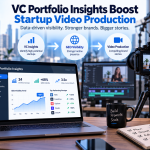

A founder asked a fairly specific question before her team's first serious product video shoot, the kind of thing she'd normally just decide herself but figured the platform team would have a sharper answer for: should this run ninety seconds or closer to three minutes. The platform team gave an answer based on general industry wisdom, the kind that shows up in every marketing blog post about video length. Nobody at the firm had looked at their own portfolio's video performance to check whether that general wisdom held up for companies at this stage, in this category, talking to this specific kind of buyer. The advice was reasonable. It just wasn't informed by anything the fund had produced and measured itself.
An enormous amount of video, almost none of it compared
Funds that support serious video production across their portfolio accumulate something unusual without necessarily realizing it, an unusually rich library of comparable video assets, produced under similar constraints, aimed at similar auBlockedword/sentencences, each one with completion rates, click-through data, and conversion numbers sitting somewhere in an analytics dashboard nobody has pulled together. Each video gets evaluated on its own terms when it launches. Did this specific asset help this specific company. Rarely does anyone step back and ask what twenty or thirty of these videos, viewed together, reveal about what works and what quietly doesn't across the fund's own portfolio rather than some generic industry benchmark pulled from a marketing report.
Why the comparison never happens by default
Video production sits with the platform team, usually managed project by project as requests come in. Portfolio-wide data analysis sits somewhere else entirely, often with whoever owns reporting tools or investor relations. These two functions rarely occupy the same meeting, let alone the same spreadsheet. A video wraps, gets published, and the team moves to the next request in the queue without much of a pause to look back. The performance data exists somewhere, buried in a company's own analytics account that the fund may not even have regular access to, and nobody circles back months later to connect that specific video's performance to the five other videos the fund produced in the same quarter.
What changes once the comparison happens
Real Portfolio Insights for VC Firms capabilities start to matter here the moment they include video performance alongside the usual growth and financial metrics a firm already tracks. Which video lengths correlate with higher completion rates for B2B SaaS demos specifically, as opposed to wBlockedword/sentencever a generic best-practices article recommends for video in general. Which opening seconds keep viewers watching versus which ones lose them in the first five. None of this requires enough data to satisfy a rigorous academic study, and nobody's claiming it does. But a fund that's produced forty videos across its portfolio has forty concrete data points about what worked in front of forty different auBlockedword/sentencences, which beats a single agency's general opinion by a wide margin when a founder is trying to decide something specific about their own upcoming shoot.
Feeding that insight back into the next production
This is exactly where the value loops back into stronger Startup video production for the next company in the queue. Instead of a creative team guessing at pacing, structure, and length based on general instinct alone, they start from what the fund's own portfolio has already shown works for comparable companies at a comparable stage and facing a comparable buyer. That specificity changes the creative brief meaningfully. A founder gets told their demo should probably open with the product solving a visible problem within the first eight seconds, not because a marketing blog said so, but because three portfolio companies in adjacent categories saw completion rates drop sharply whenever they opened any other way. That's a fundamentally different kind of guidance than borrowed best practice.
A pattern that shows up once enough videos exist
Consider a fund with two years of consistent video production behind it, roughly thirty-five assets across various portfolio companies at different stages. Reviewing that library together instead of one video at a time surfaces things nobody would have guessed from any single project. Maybe founder-led testimonial videos consistently outperform polished narrator-voiced explainers for early-stage B2B products specifically, even though the polished versions look more expensive and impressive in a pitch deck review. Maybe videos under ninety seconds convert meaningfully better for outbound use but longer format works better embedded on a pricing page where the visitor has already shown real intent. These patterns only become visible once someone bothers to line up the results side by side.
Why this compounds the way individual production never can
The advantage here scales with volume in a way no single company's video strategy ever could on its own. A fund's fifteenth video-related decision draws on comparative evidence its first decision simply couldn't access, because that evidence didn't exist yet. Firms building this discipline develop sharper creative instincts over time, grounded in results rather than opinion, and that edge becomes difficult for a competing fund to replicate without running the same volume of production and tracking outcomes carefully enough to learn from them.
Bringing production and insight into one loop
Video production and portfolio analytics operate as separate functions at most funds, run by different people who rarely compare notes on what performed once a project wrapped and everyone moved on. Closing that loop, feeding video performance data back into portfolio insight and feeding that insight forward into the next production brief, turns every video a fund makes into a slightly smarter decision than the one before it.