
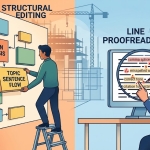






Most students finish a first draft, read it back once, and start correcting commas. The instinct makes sense a page full of small errors looks like the obvious problem. But it usually means the essay ends up with a tidy surface over an argument that's exactly as confused as it was before. Structural editing and line proofreading are different jobs. They happen at different stages, for different reasons, and mixing them up is one of the more common ways marks get lost on otherwise well-researched work.
Understanding the Topic
Structural editing looks at the essay as a whole whether the argument actually answers the question, whether each paragraph earns its place, whether the reasoning holds together from introduction to conclusion. Line proofreading works at sentence level: grammar, word choice, punctuation, tone, citation formatting. Structure comes first. Rewording a paragraph that later gets cut or moved is time you won't get back.
This distinction tends to show up once students move past foundational essay-writing modules into work assessed on the quality of argument rather than the presence of basic academic conventions. At that point, markers want a thesis that develops across the piece, not a run of accurate but loosely connected observations. For students writing in a second language, the pull toward fixing visible grammar first is even stronger sentence-level errors feel more exposing than structural ones. A grammatically clean paragraph that doesn't move the argument forward still isn't doing its job, though.
Common Problems or Concerns
Ask students revising their own work where they usually start, and the honest answer is often: paragraph one, editing forward as they go. Which is exactly how structural problems get missed you're reading in the order you wrote, not the order a marker will actually judge it in.
There's also the trouble of recognising a structural problem for what it is. A paragraph that "feels wrong" often gets rewritten sentence by sentence when the real issue is that it's answering a slightly different question from the one set, or repeating an earlier point, or sitting in the wrong place in the sequence. None of that gets fixed by rewording.
International and EAL students raise a further concern fairly often: worrying that their prose doesn't "sound academic enough." That worry pushes people toward heavy line-level polishing too early, sometimes reaching for vocabulary they wouldn't naturally use in speech. It can backfire grammatically correct sentences that are stylistically inconsistent, or that bury meaning under unfamiliar phrasing.
Key Theories or Concepts to Know
Editing theory generally splits revision into macro and micro levels sometimes called global and local revision. Global revision covers thesis clarity, argument logic, paragraph sequencing, and whether the evidence used actually supports what's claimed from it. Local revision covers grammar, syntax, word choice, formatting.
One technique worth knowing is the reverse outline. Once a draft exists, write down in a single line what each paragraph is actually arguing, then compare that list against the essay question and against itself checking for repetition, gaps, or paragraphs that don't logically follow the one before. Structural weaknesses become visible this way in a manner that simply re-reading the full text rarely achieves, because sentence-level polish tends to disguise a shaky argument.
Citation integrity sits somewhere between the two levels. Whether a source is used appropriately cited near the claim it supports, rather than dropped in as evidence of having read something is structural. Whether it's formatted to the correct referencing style is not.
Key Factors to Consider
Time is usually the biggest constraint on how thorough this process can be. A student revising the night before submission realistically gets one pass, and if that pass goes on proofreading, the argument goes uncorrected. Confidence in the language matters too a student still building fluency may need separate time budgeted for line-level revision rather than assuming it'll happen naturally during a single read-through, and depending on workload, searching for help with essay proofreading and editing is one of the more common ways students close that gap when time and language confidence are both under pressure at once. Familiarity with the subject plays a part as well: a student unsure of the theory is more likely to describe it than evaluate it, which is a structural issue, not a wording one. How the assessment criteria weight argument against expression should also steer where the revision time goes a criterion sheet that allocates most marks to critical analysis makes structural revision the priority almost by default.
Practical Guidance
Leave a gap between finishing a draft and starting to revise it even a few hours helps, a full day is better. Some distance from the writing matters more than people expect. Do the structural pass first: reread the essay question, then read only your topic sentences in sequence and check whether they form a logical argument on their own. If they don't, the paragraphs underneath won't either, no matter how well the individual sentences are written.
Once the structure holds up, check that each paragraph's evidence is doing analytical work rather than just sitting there a quotation or data point should be followed by an explanation of what it actually demonstrates, not left to speak for itself. Only then move to line-level revision. Reading aloud helps here; it catches clunky phrasing and missing words that silent reading tends to skip past. Referencing formatting comes last, checked against wBlockedword/sentencever style guide your department specifies easy to standardise once the content around it has settled.
Mistakes to Avoid
The single biggest mistake is proofreading before restructuring. It wastes effort polishing text that might not survive the structural pass at all. Another is treating every marker comment from a previous essay as a language problem when it was actually about argument. "Unclear" in feedback often means the reasoning wasn't followed, not that a sentence was grammatically wrong mixing the two up means the same feedback keeps showing up essay after essay.
Over-correcting vocabulary to sound more formal is a third one, and it can strip the clarity out of a sentence that was already perfectly understandable. Academic tone is about precision and appropriate hedging, not about reaching for the longest available word. And then there's skipping the reverse-outline step because the essay "feels finished" that feeling usually comes from familiarity with your own writing, not from the argument actually holding up.
Bringing the Main Lessons Together
Two distinct passes work better than one blended effort: structure before language, argument before phrasing. Time spent tightening sentences is then spent on paragraphs that are actually staying in the final essay, and structural weaknesses get caught while there's still time to fix them properly rather than papered over with better wording after the fact. It's a habit worth building early. It applies to every essay after this one, not just the one currently open on the screen.