
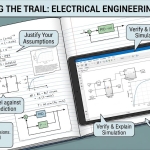






Writing a technical report for an electrical engineering module is a different exercise from writing an essay, and the gap catches a lot of students out in their second or third year. A report has to show that you understand a circuit or a control system, yes, but more than that it has to document how you got there, verify your results against a model, and present the evidence so an examiner, or later a chartered engineer, could follow it without guesswork. UK-accredited BEng and MEng programmes assess this against IET learning outcomes, and those outcomes care less about a correct final answer than about the trail leading to it.
Understanding the Topic
Technical reporting sits at the intersection of Circuit Analysis, Power Systems, and Embedded Systems, and it tends to appear once you've moved past pure theory coursework into labs, projects, or design modules where you're modelling something in MATLAB or Simulink and then writing up the comparison between prediction and outcome. That usually lands from second year onward, once Kirchhoff's laws, phasor analysis, and basic control theory are familiar enough to have something worth reporting on in the first place.
None of this is decorative. A power systems report tracking load flow results, or an embedded systems report following a PID controller's step response, is early training for the documentation expected in professional practice the kind UK-SPEC competency records eventually ask you to produce evidence of. Markers want to see reasoning, not just a simulation that ran successfully.
Common Problems or Concerns
The difficulty usually isn't technical incompetence. Plenty of students can derive a transfer function on paper without trouble but freeze up trying to explain, in prose, why their Simulink model's step response doesn't quite match the calculation, or what a 3% gap between measured and calculated power factor actually means for the reader.
There's also a habit of treating MATLAB output as self-explanatory a plot dropped into a report with no commentary on what it shows, why the axes were scaled that way, or where the interesting behaviour sits, leaves the marker doing interpretive work that was supposed to be yours. And verification gets muddled with validation more often than you'd expect: does the model behave the way the mathematics predicts, versus does the mathematics actually represent the real system. Two different questions, frequently answered as if they were one.
Key Theories or Concepts to Know
Circuit-based reports lean on phasor and frequency-domain analysis, Thevenin and Norton equivalents, and transient response via Laplace transforms all of which need to be reached for correctly when explaining gaps between simulation and calculation, not just listed as background. Power systems work runs on per-unit analysis, load flow fundamentals, and fault level calculations, where a small slip in base value selection can quietly propagate through an entire results table without ever looking obviously wrong.
Embedded systems reports draw more on control theory: open-loop against closed-loop behaviour, stability margins, and the discretisation effects that show up once a continuous-time design gets implemented on a microcontroller. Simulink underpins all three areas, and one thing that rarely gets taught explicitly but shows up constantly in write-ups is solver behaviour fixed-step versus variable-step, and why the choice changes your numbers.
Key Factors to Consider
A handful of things tend to decide whether a report actually convinces: consistency between the derivation, the simulation, and the written explanation; assumptions stated up front rather than buried (component tolerances, idealised versus real behaviour, sampling limitations); and honesty about mismatches between expected and observed results instead of quietly smoothing them over in the write-up. Deadlines cluster badly across modules, and when that collides with how much depth a report demands, some students look at options such as electrical engineering coursework help uk though wBlockedword/sentencever gets produced, the underlying reasoning still has to be something you can defend yourself if a marker or supervisor follows up on it. What separates a strong report from an average one usually has less to do with polish than with whether the logic holds together from start to finish, each step earning the next rather than being left to speak for itself.
Practical Guidance
Get the schematic or block diagram right before opening MATLAB. A Simulink model built on a shaky system definition tends to accumulate small errors that are miserable to trace back later. Every plot needs a sentence next to it stating what it shows and, where it matters, how it stacks up against the hand-calculated prediction a graph on its own doesn't argue anything.
Keep a running log of solver settings, tolerances, and parameter sweeps as you go, even scrappy notes, because reconstructing why you picked a particular time step three days before a deadline is a bad use of remaining hours. For power systems work specifically, state your base values right next to the per-unit calculations an otherwise correct answer loses marks constantly just because the base wasn't shown. And when hardware results don't match simulation, don't just flag the gap; take a stab at why (component tolerance, parasitics, measurement noise), even without fully resolving it. The attempt at reasoning usually counts for more than a suspiciously clean match would.
Mistakes to Avoid
Dumping a MATLAB script into an appendix without walking through the logic in the main text is a common one markers shouldn't have to reverse-engineer your method from code comments. Quoting results to more decimal places than your measurement or simulation precision supports is another; it overstates confidence you don't actually have in the number.
Limitations get skipped too often. Every simplification ignoring winding resistance, assuming ideal sBlockedword/sentenceing, linearising something that isn't linear needs to be named, because leaving it unstated reads as either not noticing or not caring, and neither is a good look to a marker. And there's a structural mistake worth watching for: writing the report as a chronological account of what you did, rather than as an argument building toward a conclusion. That buries the best analysis under procedural detail nobody needed.
Bringing the Main Lessons Together
A report earns credibility roughly the way a good circuit design does through consistency, stated assumptions, and results that survive being questioned rather than results that just look tidy. Build the habit early of treating every plot, every calculated value, and every simplification as something you might have to explain out loud, because at some point, in a viva or a design review, you will be asked. It's a slower way to write a report. It also tends to be the difference between one that reads as competent and one that reads as thought-through.