



Preparing for the IBPS Clerk examination requires a combination of conceptual understanding, regular practice, and effective time management. Candidates often spend hours studying individual topics but find it difficult to maintain speed and accuracy when solving questions under exam conditions.
This is why practice should become an important part of the preparation routine. An IBPS Clerk Mock Test can help candidates experience timed exam-style practice, while sample papers provide additional opportunities to work through different types of questions.
Used together, these resources can help aspirants understand their strengths, identify weak areas, and develop a more practical approach to the examination.
Why Take an IBPS Clerk Mock Test?
A mock test provides an opportunity to practise questions in a structured and time-bound environment. Instead of solving questions casually, candidates have to make decisions about which questions to attempt and how much time to spend on them.
Candidates can use an IBPS Clerk Mock Test to assess their preparation and practise handling different sections within the available time.
Regular mock-test practice can help improve:
- Speed and accuracy
- Time management
- Question-selection sBlockedword/sentences
- Familiarity with online examination conditions
- Confidence while attempting a complete paper
The purpose of a mock test is not simply to obtain a high score. It should help candidates understand what they need to improve before the actual examination.
How an IBPS Clerk Sample Paper Helps
Sample papers are another useful resource for structured preparation. They allow candidates to practise different question formats and apply the concepts they have stuBlockedword/sentenced.
An IBPS Clerk Sample Paper can be included in regular study sessions to strengthen problem-solving sBlockedword/sentences and provide additional exam-oriented practice.
Candidates can use sample papers to:
- Practise individual sections
- Revise important concepts
- Work on questions they find challenging
- Improve solving speed
- Test their understanding after completing a topic
Sample papers are particularly useful when combined with careful review of incorrect answers.
Mock Tests and Sample Papers Serve Different Purposes
Although both resources contain practice questions, they should not be used in exactly the same way.
A sample paper can be useful for focused practice. For example, a candidate who has recently revised a particular topic can solve relevant questions to check their understanding.
A mock test, on the other hand, is more suitable for testing overall readiness. It requires candidates to sBlockedword/sentence between sections, manage time, and maintain concentration throughout the test.
Using both resources gives preparation a better balance between targeted practice and full-test simulation.
Create a Simple Practice Routine
Candidates do not need to take multiple mock tests every day. A more effective approach is to create a routine that combines learning, practice, and analysis.
Step 1: Study the Concept
Begin by understanding the relevant topic. Make sure you know the basic methods, formulas, rules, and concepts before moving to extensive question practice.
Step 2: Solve Sample Questions
Use an IBPS Clerk Sample Paper or topic-based questions to apply what you have learned. Start by prioritising accuracy rather than speed.
Step 3: Attempt a Timed Mock Test
Once you have covered sufficient topics, take an IBPS Clerk Mock Test under timed conditions. Avoid referring to notes while attempting it.
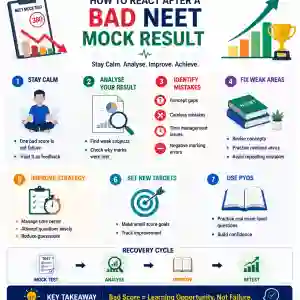
Step 4: Analyse Your Performance
After finishing the test, review your answers carefully. Identify conceptual mistakes, calculation errors, questions that took too long, and questions you skipped unnecessarily.
This four-step cycle can make practice more meaningful.
Analyse Mistakes Instead of Only Checking Scores
A mock-test score provides useful information, but it does not explain the reason behind the result. Candidates should spend time analysing their performance after every test.
For each incorrect question, ask:
- Did I misunderstand the concept?
- Did I make a calculation or reading mistake?
- Did I use an inefficient method?
- Did I spend too much time on the question?
The answers can reveal patterns in your preparation. If the same type of mistake appears repeatedly, that topic deserves additional revision.
Improve Time Management Through Practice
Time management is particularly important in competitive examinations. Candidates may know how to solve a question but still lose valuable time by spending too long on one problem.
Mock tests provide a safe environment to experiment with different approaches. Candidates can observe which questions they solve quickly and which ones consistently consume more time.
With repeated practice, they can develop a personal strategy for deciding when to attempt a question and when to move on.
Focus on Accuracy Along With Speed
Increasing speed without maintaining accuracy can lead to unnecessary mistakes. Candidates should therefore work on both aspects simultaneously.
During early practice sessions, focus on solving questions correctly. Once accuracy becomes consistent, gradually introduce stricter time limits.
This approach helps candidates build speed without sacrificing their understanding or precision.
Common Mistakes to Avoid
Taking Mock Tests Without Preparation
If the basic concepts are unclear, repeatedly attempting full-length tests may not be the best use of study time. Strengthen fundamentals and practise relevant questions first.
Ignoring Difficult Questions
Candidates should not simply look at the correct answer and move on. They should understand why they struggled and learn the appropriate method.
Taking Tests Without Reviewing Them
A test that is never analysed provides limited learning value. Always reserve time after a mock test to review mistakes and identify areas for improvement.
Focusing Only on the Number of Tests
Completing a large number of tests is not the objective. Meaningful improvement comes from learning from each attempt.
How to Track Your Progress
Maintaining a simple record of mock-test performance can make improvement easier to measure. Candidates can record their score, accuracy, time management issues, and recurring weak topics.
For example, if a candidate repeatedly loses marks because of calculation mistakes, they can add targeted calculation practice to their weekly schedule.
Similarly, if a particular section consistently takes too much time, the candidate can practise that section separately before attempting another full-length test.
Final Thoughts
Effective IBPS Clerk preparation requires more than completing study material. Candidates also need to practise applying what they have learned under realistic time constraints.
An IBPS Clerk Mock Test provides valuable full-test practice, while an IBPS Clerk Sample Paper can support targeted question-solving and revision. When combined with consistent study and detailed mistake analysis, these resources can help candidates improve speed, accuracy, and exam readiness.
The key is to treat every practice session as an opportunity to learn. Instead of focusing only on scores or the number of tests completed, identify what went wrong, correct it, and apply the lesson in the next attempt. This approach can make preparation more focused, measurable, and productive.