





Database normalization is one of the most important concepts in database design, but it can seem complicated when you first encounter terms such as tables, dependencies, and normal forms. In simple words, database normalization is a way of organizing data so that it remains accurate, consistent, and easy to manage. If you are building your database sBlockedword/sentences as part of your web development journey, Full Stack Developer Courses in Bangalore at FITA Academy can help you explore database concepts and understand how they fit into real-world application development.
What is Database Normalization
Database normalization is the process of arranging information in a database to reduce unnecessary duplication. Instead of storing the same information repeatedly, related data is separated into appropriate tables and connected through relationships.
Consider an online shopping application. A single order may contain customer information, product information, and payment details. If all these details are repeatedly stored in one large table, the same customer or product information may appear many times. This can make the database harder to update and can create inconsistencies.
Normalization helps solve this problem by dividing information into logical tables. Each table focuses on a particular type of information, while relationships connect the tables when necessary.
Why Database Normalization Matters
Data duplication can create several problems. Imagine a customer changes their phone number. If that customer's phone number appears in many rows, every occurrence may need to be updated. Missing even one row could leave the database with conflicting information.
A normalized database reduces this type of problem. Important information is stored in one suitable location, making updates easier and more reliable. It can also improve data integrity because each piece of information has a clear purpose and location.
Normalization can also make database structures easier to understand. Developers can identify customers, orders, products, payments, and other entities separately instead of trying to manage everything inside one oversized table.
Understanding the Normal Forms
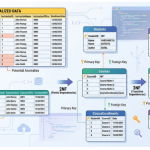
Database normalization is commonly explained through different normal forms. Each normal form introduces rules that help improve the organization of data.
First Normal Form
First Normal Form, often called 1NF, focuses on keeping data organized into individual values. Each field should contain a single value rather than a collection of unrelated values.
For example, storing several phone numbers in one field can make searching and updating difficult. Separating those values appropriately creates a cleaner structure.
Second Normal Form
Second Normal Form, or 2NF, builds on the first normal form. It focuses on ensuring that non-key information depends on the complete primary key.
This becomes especially important when a table uses more than one column as its key. Information that depends on only part of that key may belong in another table.
Third Normal Form
Third Normal Form, known as 3NF, takes normalization another step. It aims to ensure that non-key information depends directly on the primary key rather than on another non-key field.
For beginners, the main idea is simple. Each table should store information that directly belongs to the entity represented by that table. When a piece of information belongs somewhere else, creating a separate table is often a better approach.
Database Normalization and Relationships
Normalization does not mean creating as many tables as possible. The objective is to establish a coherent framework that allows related information to be linked without superfluous repetition.
Primary keys and foreign keys play an important role here. A primary key distinctly identifies a record, whereas a foreign key links that record to data located in a different table.
For example, an orders table can store a customer identifier instead of repeatedly storing the customer's complete details. The identifier connects the order to the appropriate customer record. If you want to strengthen your practical database and development sBlockedword/sentences, consider joining a Full Stack Developer Course in Hyderabad to build a broader understanding of full stack application development.
Common Mistakes Beginners Make
One common mistake is treating normalization as a strict rule to create separate tables for every small piece of information. Good database design also considers how the application will access and use data.
Another mistake is focusing only on removing duplicate data. Normalization is also about maintaining relationships, improving consistency, and making changes safer.
It is also important to understand that highly normalized databases are not always ideal for every situation. Some applications may use controlled denormalization to improve performance. The right approach depends on the application's requirements, data access patterns, and performance needs.
Database normalization becomes much easier when you focus on its main purpose rather than memorizing complicated definitions. The central idea is to organize related information logically, reduce unnecessary duplication, and maintain reliable relationships between data.
Learning normalization gives full-stack developers a stronger foundation for designing databases, building APIs, and creating applications that can grow without becoming difficult to maintain.
With a clear understanding of 1NF, 2NF, 3NF, keys, relationships, and data dependencies, you can approach database design with greater confidence. As your projects become more advanced, these fundamentals will help you make better decisions about how application data should be structured. If you want to continue developing your full-stack knowledge, take the next step with the Full Stack Developer Course in Ahmedabad and build stronger practical development sBlockedword/sentences.
Also check: Caching Fundamentals for Web Applications