


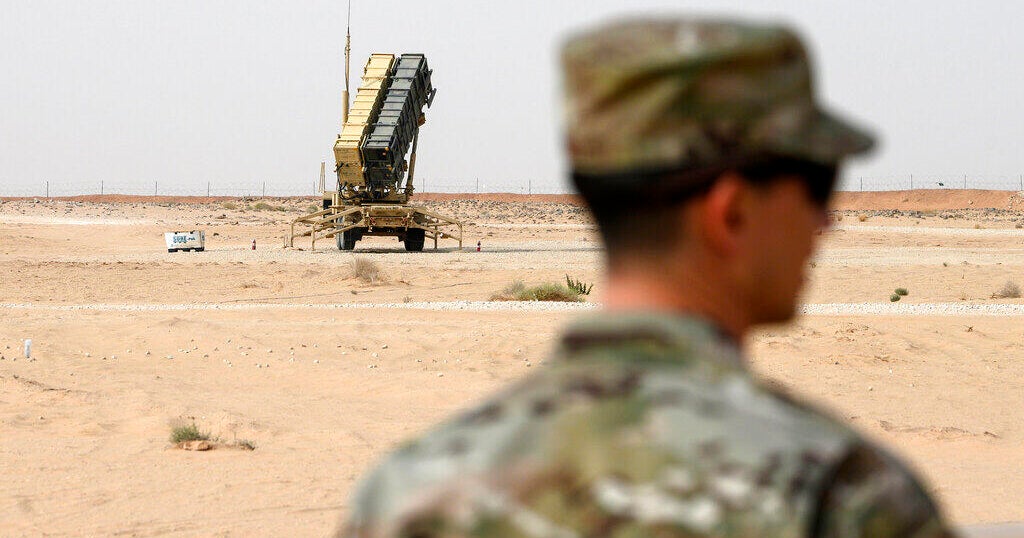
How hard would it be to remove or destroy Iran's nuclear stockpile? President Trump has said eliminating the country's nuclear weapons capability is a key objective of his military campaign against Iran, but U.S. military experts say it would be one of the riskiest missions ever attempted.
Last June, the United States significantly degraded Iran's nuclear infrastructure with massive "bunker buster" bombs designed to reach deeply buried material. But the International Atomic Energy Agency says Iran still maintains about 972 pounds of 60% enriched uranium, a short step away from the 90% enrichment levels needed for high-yield military warheads.
Without a diplomatic deal to remove or destroy the stockpile, a military operation involving boots on the ground deep in Iran is probably the only option. (An air campaign with massive bunker buster munitions that might entomb the stockpile deep underground may be under consideration, but there's no guarantee the enriched uranium would be eradicated.)
U.S. Special Forces commandos have been training for decades to seize or neutralize Tehran's uranium. They've practiced repeatedly at sites in the U.S. designed to replicate the tunnels that lead to the underground stockpile. These are the military's most elite forces, who have undergone intensive physical and technical training for this type of mission.
But an operation to move or destroy the highly enriched uranium would be more difficult and complex than anything U.S. Special Operations forces have ever attempted, experts told CBS News.
"This would not only be one of the riskiest special operations missions in American history, but very possibly the largest," said CBS News national security analyst Aaron MacLean, a Marine veteran who deployed to Afghanistan in 2009-10.
When high-risk special ops go wrongThe U.S. has engaged in high-risk military operations that have ended in catastrophe, and that's weighing heavily on military planners, operators and undoubtedly Mr. Trump and his advisers.
Operation Eagle Claw was the failed 1980 mission to rescue 53 American hostages held captive by Iran after the ayatollahs took power. After a series of mishaps, including a sandstorm, mechanical problems and a helicopter collision, the operation was aborted. No hostages were rescued, but eight American service members were killed.
Thirteen years later, U.S. Special Operations forces mounted an ill-fated attempt to capture a Somali warlord in downtown Mogadishu, ending in the deaths of 18 U.S. Army rangers. The debacle, which became known as Black Hawk Down, was a searing event for generations of U.S. military officials and national security policymakers.
The importance of speedAmong the many lessons drawn from these disasters was that speed is the coin of the realm. The quicker you get to the target, achieve the objective on the ground and exit, the less that can go wrong.
Many of the U.S. military's most successful operations have been exceptionally fast. The 2011 raid on Osama Bin Laden's compound in Pakistan took approximately 38 minutes. In the operation that captured Venezuelan strongman Nicolas Maduro in January, Special Operations Forces were on the ground for less than an hour.
But MacLean said that securing Iran's nuclear stockpile could take many hours — and possibly days.
"When you're moving quickly, the enemy has less time to organize itself, less time to respond, so there's less danger to you," he said.
So, what would an operation look like?The IAEA has said Iran's nuclear stockpile is in two or possibly three locations. And U.S. and Israeli spy agencies have been singularly focused on where the enriched uranium is held.
It's stored in large steel canisters roughly the size of a home propane tank. Too large to carry out in a backpack, the canisters would have to be transported on trucks. At least half are far underground in Iran's Isfahan facility, deep in the interior of Iran. The rest is likely located underneath Iran's Natanz facility, some 70 miles from Isfahan. There is some evidence, according to the IAEA, that the Iranians moved some of the enriched uranium to a site known as Pickaxe Mountain, close to Natanz. To secure all of Iran's stockpiles, U.S. forces would have to mount multiple missions, making the entire operation much more logistically difficult.
The main U.S. military contingent would be highly specialized units of Delta Force trained in "rendering safe" nuclear materials. They would likely be flown in from U.S. Naval ships in the Arabian Sea, nearly 1,000 miles away from the target. Another possibility would be to launch from Kuwait or Eastern Iraq, a considerably shorter distance.
To preserve stealth and the element of surprise, the operators might create a staging ground several miles from their objective, which might include building a makeshift landing strip. The commandos, technical experts and others would then walk to the objective on foot.
How many troops would it take?Pulling off an operation like this in the middle of a war zone would require extensive force protection for U.S. service members.
As many as 1,000 troops could be required to secure a perimeter around the target site. This is often the work of U.S. Army Rangers. But for a highly specialized mission like this, the military might also rely on the 82nd Airborne Division. Some elements of the 82nd have started to move into the Middle East, fueling speculation that it could be preparing for an operation to seize Iran's nuclear stockpiles.
The military would also have to protect against possible Iranian drone and missile attacks. To start, they would need to establish air supremacy, but beyond that, they would also need to put together a layered defense to protect against projectiles and other aerial threats from the Iranians. That could include small interceptor drones launched from the ground, as well as electronic warfare to jam the incoming drones' signals. One out-of-the-box possibility that concerns war planners, MacLean said, is that the Iranian regime would fire a ballistic missile to kill as many Americans as possible — even at the expense of destroying its own nuclear infrastructure.
Breaching the tunnelsOnce the perimeter is secure, the commandos would attempt to breach the fortified tunnels that lead to the uranium stockpiles. This could be one of the mission's most challenging and time-consuming endeavors.
Many of the tunnels collapsed under the massive precision U.S. air strikes last June. Satellite images indicate that the Iranians subsequently broke through the rubble to open the tunnel entrances, perhaps to gain access to the nuclear materials. But according to Joseph Rodgers, deputy director and fellow, Project on Nuclear Issues at the Center for Strategic and International Studies, more recent satellite pictures indicate the Iranians sealed up the entrances with tons of dirt and possibly concrete to defend against a U.S. or Israeli ground operation.
To breach the tunnels, U.S. commandos would need heavy earth-moving equipment as well as "explosives teams to go in and demolish the tunnel entrances and blow paths into the facilities," according to Rodgers.
Booby-traps and other risks
Once they make their way inside, the challenges multiply.
One fear — and expectation — is that the Iranians have extensively booby-trapped the sites with mines, trip-wire-activated explosives and IEDs. Explosive ordinance teams would have to identify and neutralize such threats.
Another is the danger of contamination from the fissile material. "People would have to wear breathing-apparatus suits and radioactive-protective equipment and chemical-protective equipment," Rodgers said.
Remove or destroy?Once the Delta Force operators and technicians reach the canisters, they would have to make one of their most crucial tactical decisions: Do they remove them and transport them out of the country, or destroy the stockpile?
Removal would be the most desirable option, but it would also take the most time, in part because of the high likelihood that the Iranians have mixed hundreds of decoy canisters among those that actually contain highly enriched uranium. More time means more risk.
What about destroying the stockpile by blowing up the canisters? That would present serious environmental risk.
"That option would create a lot of chemical contamination," said Rodgers. "If the uranium hexafluoride comes in contact with oxygen, it forms poisonous gasses."
Moreover, Rodgers pointed out, it is possible that the Iranians would be able to retrieve some of the enriched uranium even after the canisters were blown up.
The final challenge: Getting out aliveGetting the forces out after their task has been accomplished — what the military calls "exfiltration" — is often the riskiest part of the mission. By then, the element of surprise is gone, the force may face enemy reinforcements, and the operators' exhaustion increases the likelihood of mistakes.
"Coming home is always more dangerous," said MacLean.
If they can successfully complete the extraction or destruction of the nuclear material without significant casualties, they will have achieved the greatest setback to Iran's nuclear program in its history. If things go awry, they will have participated in another mission that went down in ignominy for the U.S. military and its political leaders.
More from CBS News
CPAC 2026 kicks off as conservatives gather in Grapevine FBI Director Kash Patel's personal email breached by hackers linked to Iran
 Nuclear submarine in Boston for commissioning
 U.S. strike on alleged drug boat kills 4 in the Caribbean Sea, military says
Go deeper with The Free Press
Trump Keeps His Promise on Iran. The World Is Safer for It. Joe Kent Has a Theory on Iran. Donald Trump Has Another.