


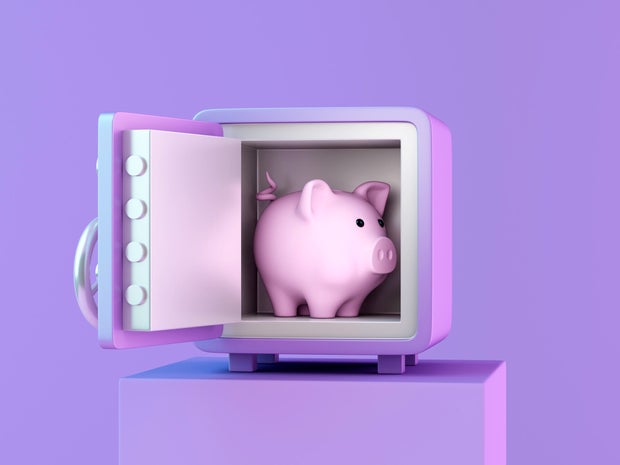
 A CD account offers viable protection for your money heading into 2026.
AlexSecret/Getty Images
A CD account offers viable protection for your money heading into 2026.
AlexSecret/Getty Images
The Federal Reserve has been consistently lowering interest rates over the last year, making a certificate of deposit (CD) account a less appealing prospect than it was in 2023 and 2024 when interest rates were higher. Despite this, CD interest rates still offer a great chance to earn a decent fixed rate of return on your money that you might not earn otherwise.
The best CD rates hover between 3.5% and 4%, which are generous returns compared to a traditional savings account. These rates can help your savings grow faster than the current inflation rate, offsetting the reduced buying power of your hard-earned money.
However, before you decide to open a CD account to park your money in, you should understand the current CD interest rate forecast, terms, risks, and potential penalties you'll be exposed to. To help with your decision, we spoke with experts about how to navigate the terms you'll face when choosing whether you should, or where you might, open a CD account before 2026 rolls around.
See how much you could be earning on your money with a top CD account here.
Costly CD account mistakes to avoid before 2026Mistakes consumers make when opening a CD account vary. What works for you will depend on variables like your income, expenses and liquidity. Here are the most common mistakes people make when opening a new CD, according to experts:
Not thinking about your time horizonExperts advise maintaining enough liquidity to last the full term of your CD by assessing how much cash you want on hand before you lock those funds away. When you open a CD account, you're tying that money up over a fixed period. Since you won't be able to access it without a penalty, you should make sure that you have enough cash to sustain your needs, lifestyle, and emergencies until your CD matures.
Penalties vary by institution and term, but you generally want to avoid them. A good practice to avoid penalties would be to evaluate how much cash you'll need over the potential CD term ahead of opening your account. Calculate your potential expenses and how much money you're comfortable committing to an emergency fund. Whatever is left over is what you would deposit in a CD.
"It's more important to compare rates, understand the terms, and make sure the money won't be needed during the certificate of deposit period," says Ryan Marshall, Partner & Financial Planner at ELA Financial Group. "Avoid locking everything into a single CD. Laddering CDs across different maturities lets you earn competitive rates while still having money come available at scheduled intervals."
You can also open different CDs at scheduled intervals to avoid a cash shortage in your savings by incrementally freeing up cash. Staggering your accounts will also help you earn competitive rates during times of volatile rate changes, and it is good practice during times when rates are increasing over the short term. However, since rate forecasts indicate lower rates in 2026, it might be worth depositing your cash over longer CD terms right now. This practice ensures you lock in current CD rates, which are likely to be higher than CD interest rate predictions for the latter half of 2026.
Compare current CD rates and terms here to learn more.
Not shopping aroundThere may only be weeks left in 2025 to shop around, but where you choose to grow your money is an important decision. You also need to consider how long you want to let it grow. Shopping around for a CD means looking at the institution's policies, term lengths and considering current market conditions.
Before looking at any rates, you should first identify how long you want to deposit your money for. Once you know that, you can find a good CD rate by looking at what different banks are offering. You might find that one bank has a high rate for the term you're looking for, while another bank might reserve its highest rates for terms that don't match your needs. Choosing the highest rate isn't always the best practice because you might need that money sooner than the period offered at that rate.
"When you're looking for a certificate of deposit, there are huge differences between one that's run of the mill and one that's really, really good," says Jean Chatzky, CEO and Founder of HerMoney. "Finding the really good ones is not difficult, it's just a matter of searching."
Delaying decisionsShop around but be decisive. There is no sense waiting and laboring on choosing a CD because your money will be sitting and "the time that you delay putting your money to work is money lost," says Chatzky.
Identify a CD account that works for you and your goals and act. CD account rates are typically higher than a traditional savings account anyway, so even if you don't get the highest-earning CD, you'll still be in better shape than if you didn't pick one at all.
You also should not consider the job done once you've deposited your money. Although your cash will sit and grow for the length of your CD term, you should remain proactive and remember that the term will end eventually. When that time comes, you need to know how you want to proceed with your original deposit plus any interest it accrued.
"CDs are excellent for predictable growth, but only if you plan your deposits, terms, and exit strategy carefully," says Nadia Vanderhall, a financial planner. "Track the maturity, match it to your goals, and always decide in advance what you'll do next. Don't just let it roll over automatically."
Sitting on your deposit until it reaches maturity without a plan other than an auto-renewal can be a costly mistake when your CD term ends because you originally planned to only tie that money up for the term you identified at the time of your original deposit. If you decide to renew that term automatically you may not have considered if you can afford not to have that money at the end of the first term. Before any auto-renewal occurs, make sure you reassess your deposit by considering your time horizon and shopping around to see if there are more competitive offers.
Why timing matters when opening a CDWhether you plan to open one for the first time or have a CD account set to mature in 2026, you should know that the Federal Reserve has lowered interest rates on a consistent basis over the last year. CD rate predictions for 2026 also point to further rate cuts. Opening a CD account isn't necessarily a decision you make because of the year's end, but it's one you make because you anticipate future rates to be lower than they are today.
Tying up your money at today's CD account interest rates could be a good decision because it's possible the Federal Reserve will continue to lower rates in 2026. However, even if rates don't go down, "what's not happening in the conversation is interest going up," says Chatzky.
The bottom lineIf you're still wary of committing your money to a CD account at the current rates, a great alternative is a high-yield savings account (HYSA). A HYSA is more flexible because you can access your money whenever you want. However, these accounts don't usually have the most competitive rates compared with CD accounts, and the rates are variable. If the Fed lowers rates, your HYSA rate goes down with it. However, if your time horizon is unpredictable and you want to continue shopping for the right CD account, parking your money in a HYSA in the meantime will be a great way to maintain liquidity and offset the difference between CD interest rates and not earning any interest at all.